Ballistic Coefficient Calculator

Use our Ballistic Coefficient Calculator to find G1 or G7 BC from velocity, mass, diameter, and form factor. Get clear results for physics study and manual checks in class work with ease.
G1 Ballistic Coefficient
6.072

Aerodynamic efficiency index (G1)

Sectional Density (SD)
0.253

lbs/in² (Mass-to-frontal-area ratio)

Form Factor (i)
0.042

Drag relative to standard projectile

Calculated G1 Ballistic Coefficient is 6.072. Sectional density is 0.253 lbs/in².

What Is Ballistics?

Ballistics explains how a projectile moves after launch. It includes speed, air drag, trajectory, and energy. Understanding these ideas helps students connect physics equations with measured motion.

What Is Ballistic Coefficient?

Ballistic coefficient measures how well a projectile resists air drag. A higher value usually means slower speed loss, but the result depends on the chosen drag model and projectile shape.

G1 vs. G7 Drag Models

G1 and G7 describe projectile drag against different reference shapes. G1 often suits flat based bullets, while G7 often fits modern boattailed bullets more closely. Use the model that matches your data.
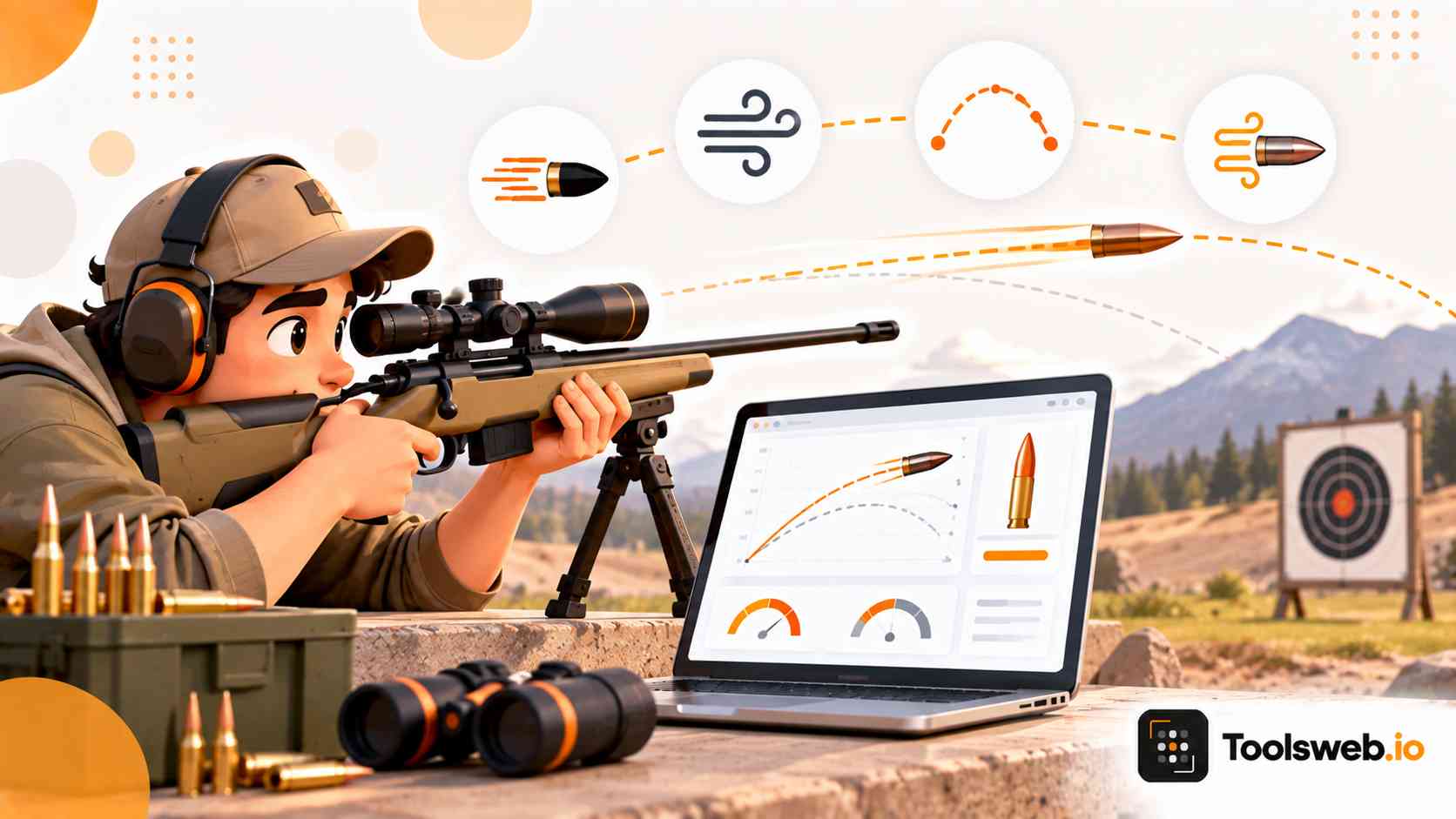
Ballistic Coefficient Calculator showing a rifle, bullet trajectory, target, and ballistic performance data on a laptop.

How can you use our Ballistic Coefficient Calculator?

Our Ballistic Coefficient Calculator lets you estimate BC using velocity data or bullet measurements. Enter the values, select the correct method, and review the calculated result.

Step 1

Enter Your Velocity Data

Enter the muzzle velocity, downrange velocity, and distance to the chronograph.

Step 2

Choose a Calculation Method

Select the velocity method or weight and diameter method, then choose the G1 or G7 standard.

Step 3

View Ballistic Results

Get the ballistic coefficient, sectional density, and form factor instantly.

Key Features of Our Ballistic Coefficient Calculator

The calculator supports G1 and G7 drag models. It accepts velocity data or bullet measurements, depending on your selected method. Clear inputs help you check your work without complex steps. Results can include ballistic coefficient, sectional density, and form factor. The page also explains the physics behind each value.

How to calculate Ballistic Coefficient manually

Formula

Use BC=SD/iBC = SD / i.

Here, SDSD is sectional density and ii is form factor. Find sectional density with SD=m/d2SD = m / d^2.

Step by step guide

  1. Convert mass and diameter to the required units.
  2. Square the bullet diameter.
  3. Divide mass by squared diameter to find SDSD.
  4. Divide SDSD by form factor to find BCBC.
  5. Choose the G1 or G7 model that matches your data.

Practical Example

If SD=0.25SD = 0.25 and i=0.80i = 0.80, then BC=0.25/0.80=0.3125BC = 0.25 / 0.80 = 0.3125. This simple example shows how the formula works.

What Affects Ballistic Coefficient?

Mass, diameter, shape, sectional density, and form factor all influence ballistic coefficient and how a projectile handles air drag.

Bullet Weight

Bullet weight changes mass and sectional density. More mass can raise BC when diameter stays fixed, but bullet shape and form factor still matter.

Bullet Diameter

Bullet diameter changes frontal area and sectional density. Diameter alone cannot determine BC because mass, shape, and the drag model also matter.

Bullet Shape

Bullet shape changes airflow and drag. Streamlined profiles can reduce resistance, while blunt profiles can create more drag during flight.

Sectional Density

Sectional density links projectile mass with diameter. It helps describe how much mass sits behind a given frontal area. You can use it with form factor to calculate BC and compare projectiles.

Form Factor

Form factor compares a projectile with a reference drag shape. A lower form factor means less drag than a higher value under the same ballistic model and test conditions. It helps estimate BC.

Applications of Ballistic Coefficient

Students can use ballistic coefficient calculations to study air drag, velocity loss, projectile motion, and trajectory. The result helps connect equations with measured data. It also shows how mass, diameter, shape, and form factor affect a projectile's motion through air. Use it as a learning tool, not as a substitute for measured data.

Bullet Shape Characteristics

Spitzer, boattail, hollow point, and roundnose designs have different shapes. Their profiles change airflow, drag, and form factor, which can change BC. A smoother profile often reduces drag during flight. Shape alone does not set the final BC.

Explore Physics Calculators

Find physics calculators for force, energy, motion, electricity, and physical quantities.

Frequently Asked Questions

These FAQs explain BC accuracy, velocity, drop, wind drift, calculation modes, typical values, caliber, units, and BC size.