What is a Concrete Calculator
A Concrete Calculator helps you find how much concrete your project needs. Enter the length, width, depth, or height to get volume and bag estimates.
33.33
112
75
56
A Concrete Calculator helps you find how much concrete your project needs. Enter the length, width, depth, or height to get volume and bag estimates.
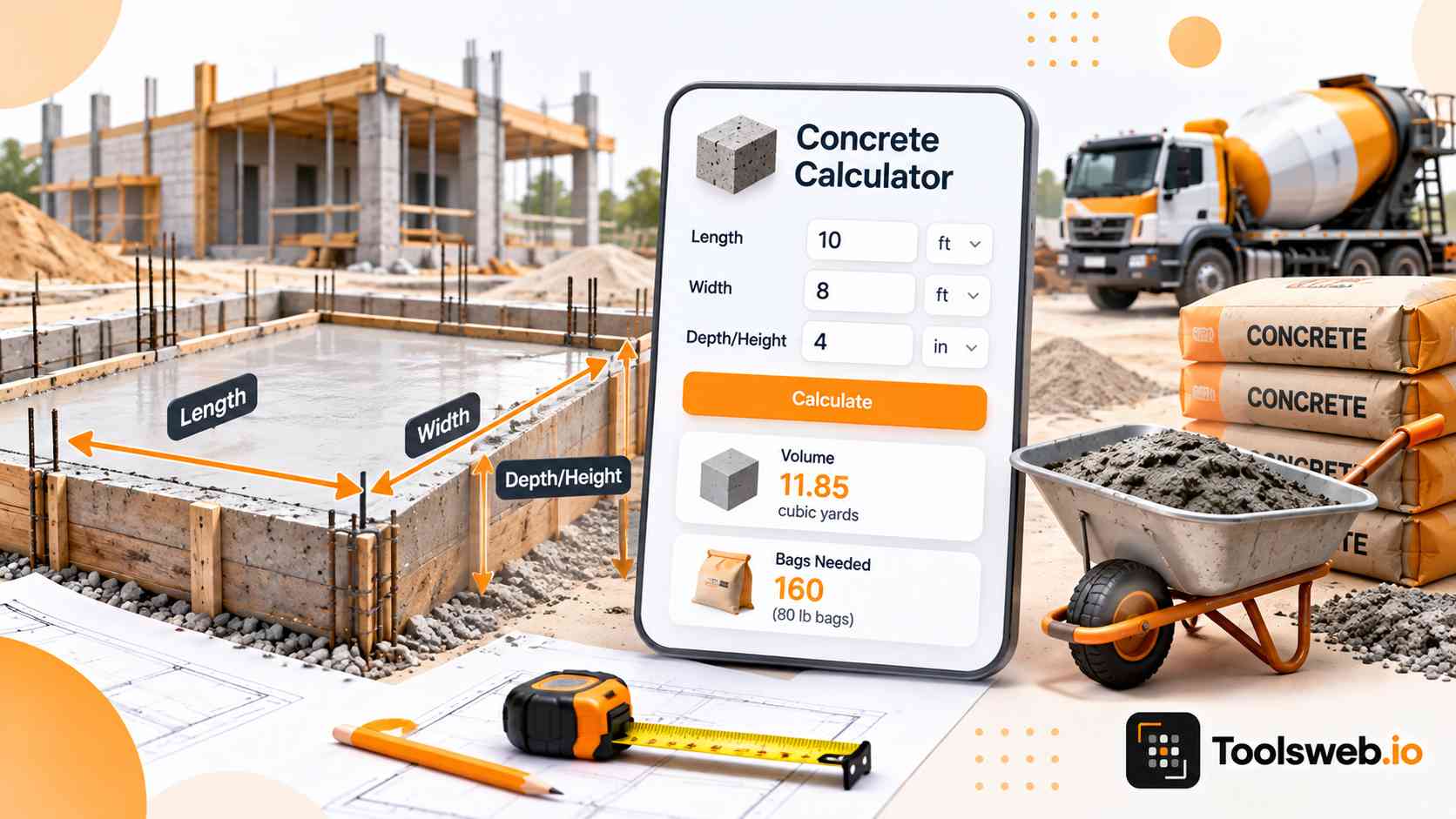
Our Concrete Calculator estimates concrete volume and concrete bags for slabs, footings, columns, and stairs. Enter your measurements and get fast results.
Select Slab, Footer, Column, or Stair based on your project.
Enter the required dimensions, such as length, width, and thickness.
Get the required concrete volume in cubic yards and cubic feet instantly.
View the estimated number of 40 lb, 60 lb, and 80 lb concrete bags needed.
Select Slab, Footer, Column, or Stair based on your project.
Enter the required dimensions, such as length, width, and thickness.
Get the required concrete volume in cubic yards and cubic feet instantly.
View the estimated number of 40 lb, 60 lb, and 80 lb concrete bags needed.
You can calculate concrete volume by multiplying the measurements for each structure. Convert inches to feet before using the formula.
A concrete slab uses length, width, and thickness to find its volume. Keep all measurements in the same unit before calculating.
Formula
Step by step Guide
Practical Example
A slab measures 12 ft × 10 ft × 4 in. Convert 4 in to 0.333 ft. Then, cubic feet. Divide by 27 to get about cubic yards.
A concrete footing supports walls, columns, or other structures. Its volume depends on length, width, and footing depth.
Formula
Step by step Guide
Practical Example
A footing measures 20 ft long, 2 ft wide, and 8 in deep. Convert 8 in to 0.667 ft. Then, cubic feet. That equals about cubic yards.
A round concrete column needs its diameter and height. You can use the cylinder formula to estimate its concrete volume.
Formula
Step by step Guide
Practical Example
A column has a 2 ft diameter and is 10 ft high. Its radius is 1 ft. The volume is cubic feet. That equals about cubic yards.
Concrete stairs need more care because each step has a different height. For a basic estimate, calculate the stepped section as stacked rectangular blocks.
Formula
Here, means the number of risers.
Step by step Guide
Practical Example
A stair is 4 ft wide with 6 in treads and 6 in risers. It has 8 risers. The volume is cubic feet. That equals cubic yards.
Concrete bags produce different amounts of concrete based on their weight and product yield. Use the product label for the most accurate coverage.
Concrete Bag Size | Typical Yield | Approx. Bags per Cubic Yard |
|---|---|---|
40 lb | 0.30 cubic ft | 90 bags |
60 lb | 0.45 cubic ft | 60 bags |
80 lb | 0.60 cubic ft | 45 bags |
Note: Actual bag yield can vary by product. Check the manufacturer's coverage information before buying concrete bags.
Our Concrete Calculator helps estimate concrete quantity for common construction projects, including slabs, footings, columns, and stairs.
Calculate concrete for patios, driveways, floors, walkways, and other flat slabs. Enter length, width, and thickness to find volume.
Estimate concrete for foundations, wall footings, and other support structures. Enter footing length, width, and depth for the volume.
Calculate concrete needed for round columns and posts. Enter the column diameter and height to estimate cubic feet and cubic yards.
Estimate concrete for basic stairs using stair width, tread depth, riser height, and the number of risers.
Tips for Accurate Concrete Estimates
Measure every dimension carefully and keep units consistent. Convert inches to feet before calculating volume. Add a suitable safety buffer for waste, uneven surfaces, and measurement errors. Always check the concrete mix yield before estimating bags.
Use construction calculators for materials, measurements, area, volume, and project planning.
These answers explain concrete volume, cubic yards, concrete weight, bag quantities, thickness, square footage, truck capacity, and project costs.