Octal to Ascii Converter

Use our Octal to Ascii Converter to turn octal values into readable ASCII text. Enter codes, get matching characters, copy the result, and learn the manual method step by step.
From
Text—
Binary—
Hexadecimal—
Decimal—
Octal—
ASCII Codes—
Recent
Nothing here yetYour recent activity will appear here

What Is the Octal Number System?

The octal number system uses base 8, so it has eight digits: 0 through 7. Students use octal to write binary values in a shorter form. Each octal digit represents three binary bits. This makes base conversion easier to read.

What Is ASCII Text

ASCII text uses standard character codes to represent letters, numbers, punctuation, and control characters. Standard ASCII contains 128 codes, from 0 through 127. Each code maps a number to a character. For example, decimal 65 represents A.
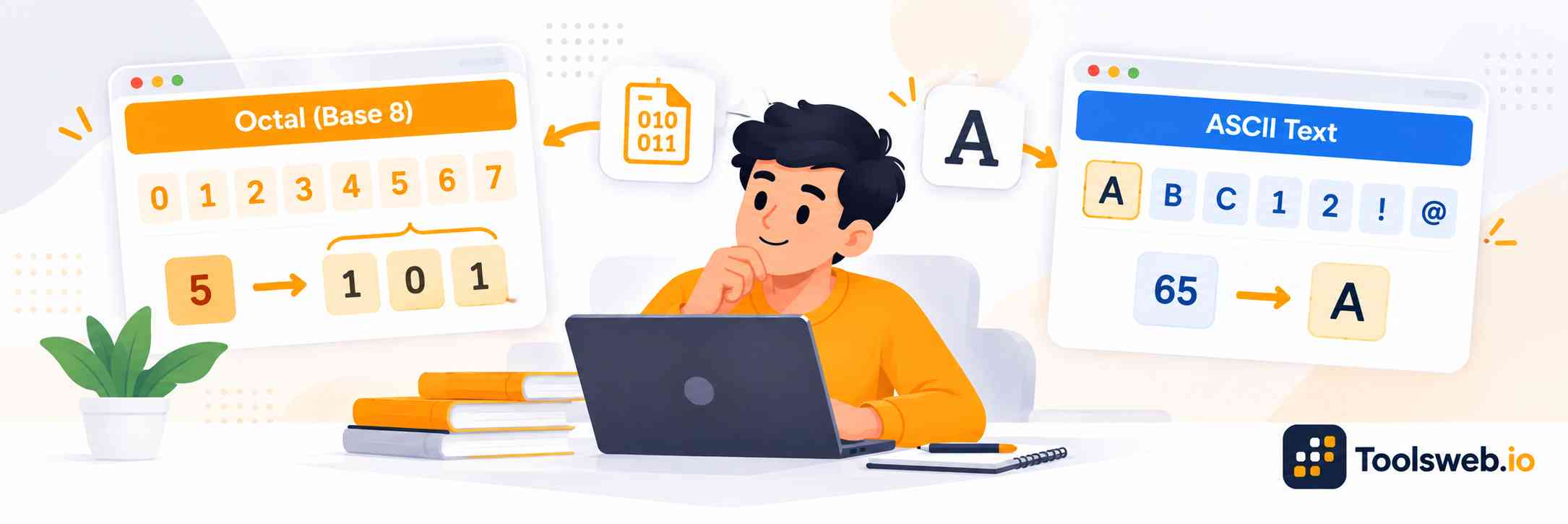
Octal to ASCII Converter converting octal values into ASCII text characters.

How can you use our Octal to ASCII Converter?

Our Octal to ASCII Converter quickly changes octal values into readable ASCII text. Enter your octal input, view the matching ASCII output, and copy the result. You can also learn the manual method and check conversion rules.

Step 1

Enter Your Octal Values

Type or paste the octal values you want to convert.

Step 2

View ASCII Result

Get the readable ASCII text instantly from your octal values.

Step 3

Copy Result

Copy the converted ASCII text for future use.

How to Convert Octal to Ascii Manually

You can convert octal to ASCII by changing each octal value into decimal, then matching that number to an ASCII character. Formula: decimal=d2×82+d1×81+d0×80decimal = d_2 × 8^2 + d_1 × 8^1 + d_0 × 8^0.

Formula

Decimal=d2×82+d1×81+d0×80Decimal = d_2 × 8^2 + d_1 × 8^1 + d_0 × 8^0

Step by step Guide

  1. Split the octal values.
  2. Convert each value to decimal.
  3. Find the matching ASCII character.
  4. Join the characters.

Practical Example

1108=7210=H110_8 = 72_{10} = H

So, octal 110 becomes the ASCII character H. The same method works for other standard ASCII values.

Octal to Ascii conversion table

Octal

Decimal

ASCII Character

Meaning

000

0

NUL

Null

001

1

SOH

Start of Heading

007

7

BEL

Bell

011

9

TAB

Tab

012

10

LF

Line Feed

040

32

Space

Space

041

33

!

Exclamation mark

042

34

"

Quotation mark

043

35

#

Number sign

101

65

A

Uppercase A

102

66

B

Uppercase B

110

72

H

Uppercase H

141

97

a

Lowercase a

145

101

e

Lowercase e

154

108

l

Lowercase l

157

111

o

Lowercase o

177

127

DEL

Delete

Note: Use three digit octal groups when possible. This keeps ASCII values clear and makes manual conversion easier to check. It also reduces grouping mistakes.

Octal to ASCII Conversion Rules

Use valid octal digits, stay within the standard ASCII range, and separate multiple values clearly. These rules help prevent wrong results.

Valid Octal Digits

Valid octal digits are 0, 1, 2, 3, 4, 5, 6, and 7. Digits 8 and 9 are not valid in the base 8 number system. Check every group before conversion.

ASCII Range

Standard ASCII uses decimal codes from 0 to 127. Common octal values range from 000 to 177 for the full set of 128 standard ASCII codes.

Separating Multiple Octal Values

Separate multiple octal values with spaces when each group represents one ASCII character. Three digit groups make each code easier to read.

What Are the Features of Our Octal to ASCII Converter?

Our Octal to ASCII Converter gives fast, clear results with a simple input area and easy copying. It helps students convert octal codes without repeated manual calculations. Each result stays easy to read, check, and copy as needed.

Common Octal to ASCII Conversion Mistakes

Common mistakes include using 8 or 9, mixing decimal with octal, joining values incorrectly, and using codes outside standard ASCII. Check each octal group before converting. Remember that base 8 allows only digits 0 through 7.

Frequently Asked Questions

These answers explain octal and ASCII conversion, spaces, valid ranges, decimal codes, and common uses for students.