What is a Triangle?
A triangle is a closed shape with three straight sides and three angles. Its angles always add to 180°. Triangles differ by side lengths and angle sizes. You can classify them by their sides or angles.
acute equilateral
1, 1, 1
60, 60, 60°
0.433
3
A triangle is a closed shape with three straight sides and three angles. Its angles always add to 180°. Triangles differ by side lengths and angle sizes. You can classify them by their sides or angles.
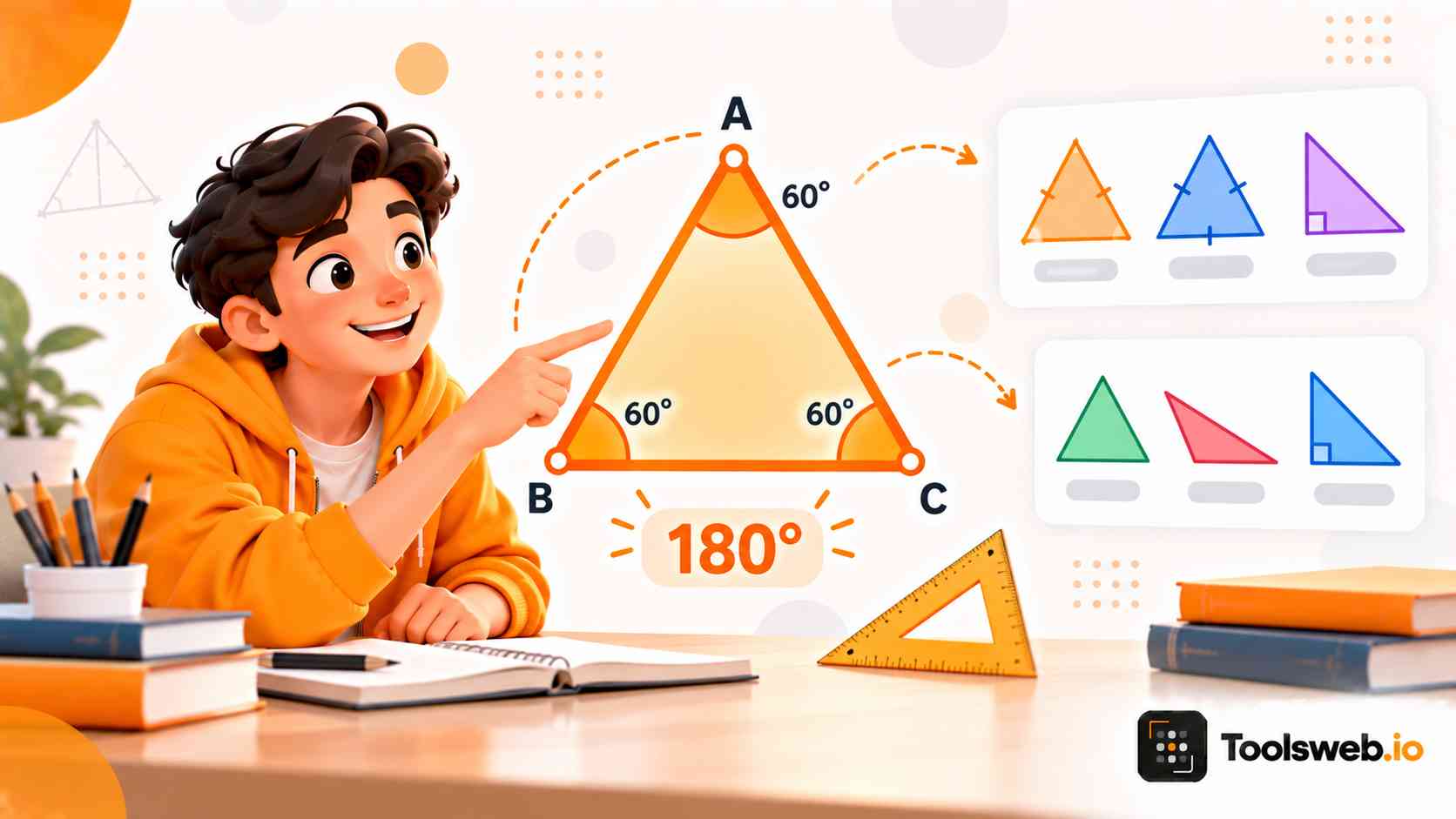
Our Triangle Calculator solves triangle sides, angles, area, and perimeter from known measurements. Use it to check homework and understand each result.
Enter the known sides and angles.
See the calculated triangle with its sides and angles.
Get the area, sides, angles, and perimeter.
Copy the calculated triangle details for future use.
Enter the known sides and angles.
See the calculated triangle with its sides and angles.
Get the area, sides, angles, and perimeter.
Copy the calculated triangle details for future use.
You can find a missing angle when you know the other two angles. Use the triangle angle sum formula: .
Formula
Step by step Guide
Practical Example
A triangle has angles of 65° and 45°. Add them: . Then subtract: . The missing angle is 70°.
This method works for every triangle because its three internal angles always total 180°.
The method depends on the triangle and the values you know. For a right triangle, use the Pythagorean theorem: .
Formula
Step by step Guide
Practical Example
A right triangle has legs of 6 and 8. Use . The missing hypotenuse is 10 units.
For other triangles, the Law of Sines or Law of Cosines can find missing side lengths.
Use the base and height when you know both measurements. The basic triangle area formula is , where is the base and is its height.
Formula
Step by step Guide
Practical Example
If cm and cm, then cm². The triangle area is 30 cm².
You can also use Heron's formula when you know all three side lengths.
A triangle's perimeter equals the total length of its three sides. Use the formula .
Formula
Step by step Guide
Practical Example
For sides of 5 cm, 7 cm, and 9 cm, use cm. The perimeter is 21 cm.
Always use the same length unit for every side before calculating the perimeter.
You need enough known sides or angles to determine the triangle. Common cases include SSS, SAS, ASA, AAS, and SSA.
With three side lengths, you can solve the triangle using SSS methods and the Law of Cosines.
With two sides and their included angle, you can use the Law of Cosines to solve the triangle.
With two angles and the side between them, use the angle sum and Law of Sines.
With two angles and one nonincluded side, find the third angle first. Then use the Law of Sines.
SSA can produce zero, one, or two possible triangles. This case creates the ambiguous case.

The calculator uses common triangle formulas to find unknown sides, angles, area, and perimeter. Your known values decide which formula works best. Right triangles use the Pythagorean theorem, while general triangles can use the Law of Sines or Law of Cosines. Area calculations can use base and height, two sides with an included angle, or Heron's formula.
Every triangle has three internal angles that add to 180°. Use to find a missing angle.
For a right triangle, use . The hypotenuse sits opposite the 90° angle.
The Law of Sines connects sides and opposite angles. Use .
The Law of Cosines finds a missing side or angle. Use for a missing side.
The basic formula is . You can also use or Heron's formula.
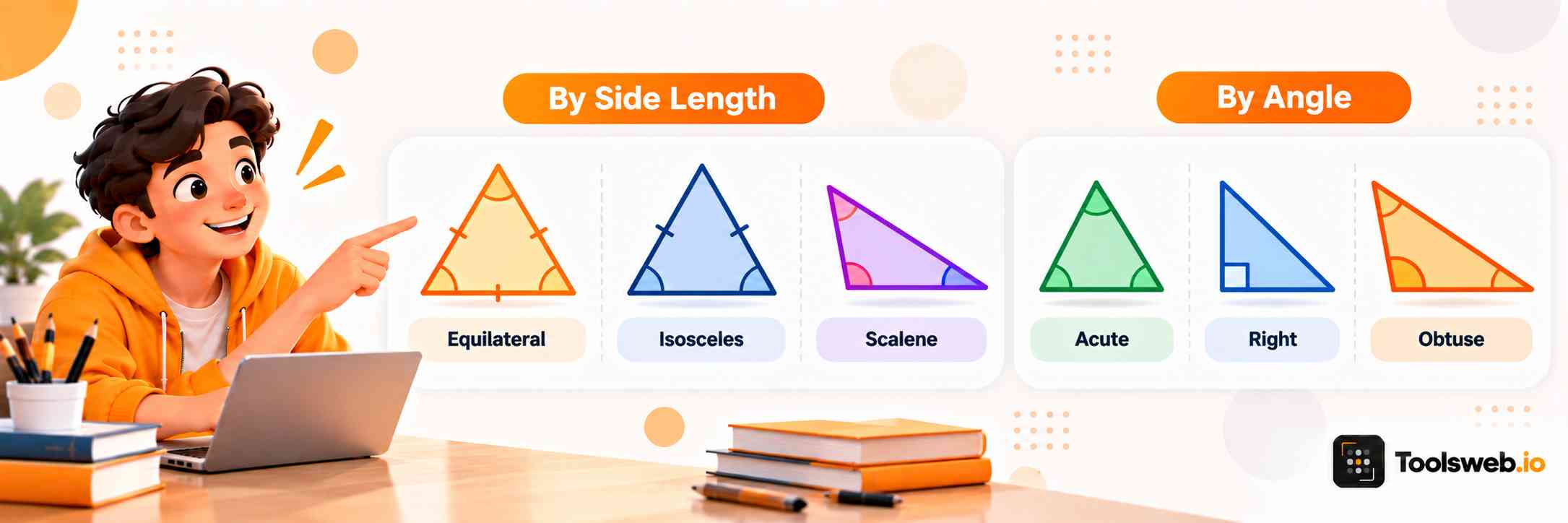
Triangles fall into groups based on side lengths or angle sizes. Knowing the type helps you choose the right geometry formula.
Side lengths create three main triangle types: equilateral, isosceles, and scalene.
An equilateral triangle has three equal sides and three equal angles. Each angle measures 60°.
An isosceles triangle has at least two equal sides. Its two opposite angles also have equal measures.
A scalene triangle has three different side lengths. Its three angles also have different measures.
Angle sizes create three main types: acute, right, and obtuse triangles.
An acute triangle has three angles smaller than 90°. Its largest angle still stays below a right angle.
A right triangle has one 90° angle. The side opposite that angle is the hypotenuse.
An obtuse triangle has one angle greater than 90°. Its other two angles must each measure less than 90°.
Common Triangle Terms
The radius of the circle inscribed inside a triangle. It is commonly denoted by r.
The radius of the circle that passes through all three vertices of a triangle. It is commonly denoted by R.
The perpendicular distance from a vertex to the opposite side or its extension.
A line segment connecting a vertex to the midpoint of the opposite side.
A line that divides an angle into two equal angles.
A line that crosses a side at its midpoint and at a 90° angle.
The distance between two vertices of a triangle, usually represented by a, b, and c.
A corner point where two sides of a triangle meet.
An angle formed inside the triangle by two adjacent sides.
An angle formed between one side of a triangle and the extension of an adjacent side.
Half of the triangle's perimeter, commonly represented by s.
The side selected as the reference side when calculating a triangle's area.
The perpendicular distance from a vertex to the base.
The longest side of a right triangle, opposite the 90° angle.
The two sides that form the right angle in a right triangle.
The point where the three medians of a triangle intersect.
The point where the three altitudes of a triangle intersect.
The point where the perpendicular bisectors of the three sides intersect.
The point where the three angle bisectors intersect and the center of the inscribed circle.
Use math calculators for algebra, geometry, percentages, fractions, equations, and more.
These answers cover common triangle questions about symmetry, side lengths, similarity, perimeter, and triangle formulas.