Biology Calculator

Free online Annealing Temperature Calculator

Use our free annealing temperature calculator to find your PCR primer melting temperature and optimal annealing temperature. Enter your primer sequence and get accurate results in seconds.
Len: 16 bpGC: 50%Basic Tm: 43.4°C
Recommended Annealing Temp (Ta)
47.4°C

Standard Taq: Ta is recommended ~5°C below primer Tm.

Forward Primer Details

Salt-Adjusted Tm:52.4°C
GC Content:50%
Length:16 nt

Reverse Primer Details

Salt-Adjusted Tm:52.4°C
GC Content:50%
Tm Difference (ΔTm):0°C
  • Forward primer length is 16 nt. Recommended PCR primer length is 18–30 nt.
  • Reverse primer length is 16 nt. Recommended PCR primer length is 18–30 nt.

What Is PCR Annealing Temperature?

PCR annealing temperature is the temperature at which primers bind to their target DNA strand. It usually sits between 55 and 65°C. Setting the correct annealing temperature ensures your PCR produces clean, specific results every time.

What Is PCR?

PCR stands for polymerase chain reaction. It is a lab method that copies a specific section of DNA millions of times. Scientists use it in medical research, clinical diagnosis, and forensic testing around the world.

Denaturation

Denaturation is the first step of each PCR cycle. The reaction heats to around 95°C. This high temperature breaks the bonds between the two DNA strands, separating them so each can serve as a copying template.

Annealing

Annealing is the second step in the thermal cycle. The temperature drops to between 55 and 65°C. Short DNA sequences called primers attach to the single-stranded template DNA at their specific target sites.

Extension

Extension is the third and final step. The temperature rises to around 72°C. DNA polymerase reads the template and builds a new complementary DNA strand, making an exact copy of the target region.

How can you use our Annealing Temperature Calculator?

Our Annealing Temperature Calculator quickly calculates PCR primer melting and recommended annealing temperatures.

Step 1

Enter Your Primer Sequences

Enter the forward and optional reverse primer sequences for your PCR reaction.

Step 2

Choose PCR Conditions

Select the polymerase mix and enter salt, magnesium, and dNTP concentrations.

Step 3

View Temperature Results

Get the recommended annealing temperature, melting temperature, GC content, and primer details instantly.

How to Calculate PCR Annealing Temperature Manually

Formula

The standard formula for PCR annealing temperature is:

Ta = 0.3 × Tmp + 0.7 × Tmt - 14.9

Here, Tmp is the primer melting temperature and Tmt is the target DNA melting temperature. Both values are measured in degrees Celsius.

Step by Step Guide

  1. Find the melting temperature (Tm) of your primer using its sequence and the nearest neighbor method.
  2. Find the Tm of your target DNA.
  3. Apply the formula: Ta = 0.3 × Tmp + 0.7 × Tmt - 14.9
  4. Use the calculated value as your starting annealing temperature.
  5. Fine tune the temperature by adjusting it by ±2°C based on your actual PCR gel results.

Practical Example

Suppose your primer has a Tm of 60°C and your target DNA has a Tm of 70°C.

Ta = (0.3 × 60) + (0.7 × 70) - 14.9

Ta = 18 + 49 - 14.9

Ta = 52.1°C

Therefore, start your PCR annealing step at approximately 52°C and optimize the temperature based on your experimental results.

What Information Does the Calculator Provide?

Our calculator gives you everything you need to set up a successful PCR reaction. It covers primer temperature, GC content, and key sequence details all in one place.

Recommended Annealing Temperature

The calculator shows the ideal temperature for the annealing step of your PCR cycle. This value reflects your primer sequence and actual reaction conditions. Use it directly in your thermocycler settings.

Primer Melting Temperature

Primer melting temperature, or Tm, is the temperature at which half the primer detaches from the DNA strand. The calculator uses the nearest-neighbor method to deliver an accurate Tm value for your sequence.

Salt Adjusted Tm

Salt concentration in your PCR buffer affects how tightly the primer binds to DNA. The calculator corrects the Tm based on your Na+ and Mg2+ levels to give a more accurate real-lab result.

GC Content

GC content shows the percentage of guanine and cytosine bases in your primer. Higher GC content means a higher Tm. The calculator displays this value instantly so you can check primer balance and quality.

Primer Length

Primer length affects how specific and stable your primer is in the reaction. Longer primers generally bind more firmly to the target DNA. The calculator reports the exact length of each primer you enter.

Tm Difference Between Primers

A large Tm difference between your forward and reverse primers can cause uneven PCR performance. The calculator displays this gap clearly so you can catch mismatched primers before running your reaction.

Understanding the Scientific Models Behind Tm Calculation

The calculator uses tested scientific models to predict Tm with precision. These models factor in sequence, salt concentration, and polymerase type.

Thermodynamic Models

The nearest-neighbor model calculates Tm from the binding energy between each adjacent base pair. It produces more precise results than simple GC-count formulas for short oligonucleotides.

Salt and Ion Adjustments

Salt ions like Na+ and Mg2+ stabilize DNA strands and raise the Tm. The calculator applies a correction factor based on your specific salt and magnesium inputs to reflect real lab conditions.

Polymerase Specific Recommendations

Different DNA polymerases perform best at different temperatures. The calculator adjusts its recommended annealing temperature based on the specific polymerase type you select.

Model Assumptions and Limitations

These models assume standard lab conditions throughout. Primers with very high or low GC content can reduce accuracy. Always confirm your result with a gradient PCR experiment when precision is critical.

An introduction to the polymerase chain reaction

The polymerase chain reaction, or PCR, is a technique that copies a specific DNA sequence into millions of identical copies. Scientists developed it in the 1980s and it transformed molecular biology forever. Today, PCR supports cancer diagnosis, DNA fingerprinting, and infectious disease detection in labs worldwide.

Annealing Temperature Calculator illustration showing PCR amplification from a single DNA molecule to millions of copies, with applications in cancer diagnosis, DNA fingerprinting, and infectious disease detection.

PCR Fundamentals You Should Understand

Understanding PCR basics helps you design better experiments and fix problems faster. These core concepts explain how DNA works and why every component in a PCR reaction matters.

DNA Structure

DNA is a double-stranded molecule shaped like a twisted ladder. Each rung is a bonded pair of bases: A with T, and G with C. This structure lets the cell store and pass on genetic information with remarkable accuracy.

DNA Replication

DNA replication copies the full genetic code every time a cell divides. An enzyme called DNA polymerase reads one strand and builds a new matching strand alongside it. PCR mimics this natural process inside a controlled lab tube.

Essential Ingredients of a PCR Reaction

Every PCR reaction requires six key components to work correctly. A missing ingredient or wrong concentration will cause the reaction to fail.

Template DNA

Template DNA is the original sample containing the target sequence you want to copy. Even a very small amount of starting material is enough for PCR to amplify it.

Forward and Reverse Primers

Primers are short DNA sequences that mark the start and end of your target region. Each reaction needs one forward and one reverse primer, both pointing toward each other.

DNA Polymerase

DNA polymerase builds the new DNA strand during the extension step. Taq polymerase is the most widely used type. High-fidelity options like Phusion produce more accurate copies with fewer errors.

dNTPs

dNTPs are the building blocks that DNA polymerase uses to construct new strands. They supply all four DNA bases: adenine, thymine, guanine, and cytosine.

Buffer

The PCR buffer maintains a stable pH and chemical environment for the reaction to run correctly. Most buffers are specifically formulated to match a particular DNA polymerase.

Magnesium Ions

Magnesium ions activate DNA polymerase and stabilize the primer-template complex. Too much or too little magnesium leads to non-specific amplification or complete loss of product.

Annealing Temperature vs Melting Temperature

Annealing temperature and melting temperature are closely related but they are not the same value. Mixing them up is one of the most common PCR setup mistakes researchers make.

Feature

Melting Temperature (Tm)

Annealing Temperature (Ta)

Definition

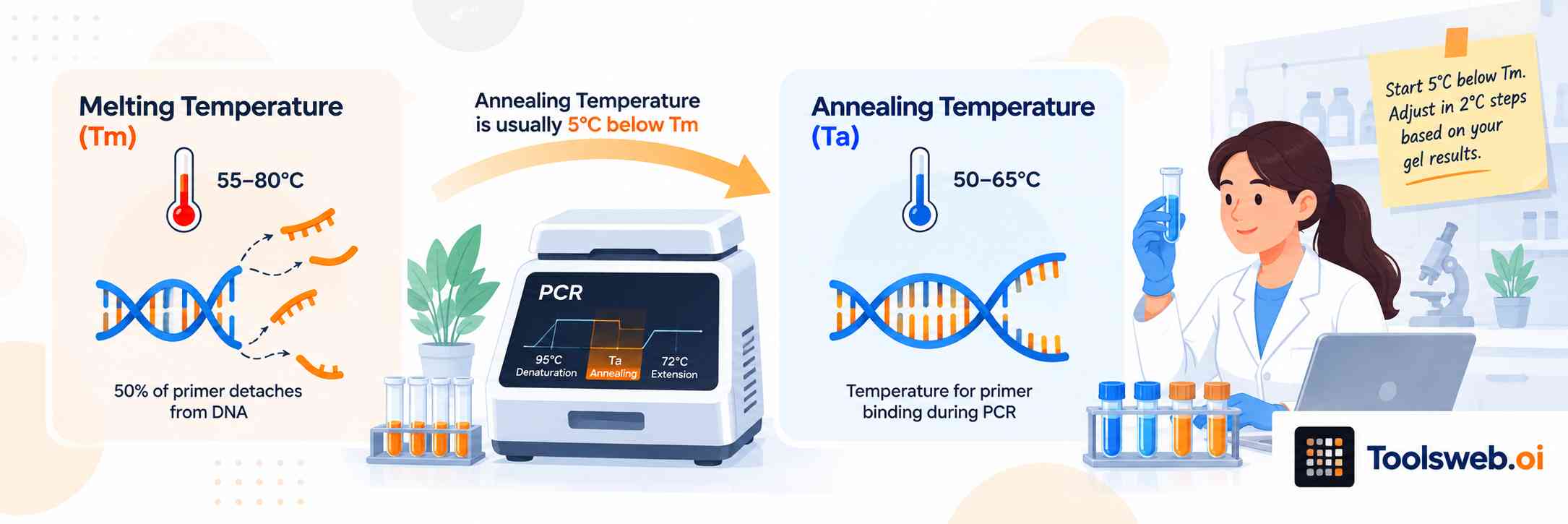
Temperature where 50% of primer detaches from DNA

Temperature set in the thermocycler for the annealing step

Typical Range

55 to 80°C depending on primer sequence

Usually 5°C below Tm (50 to 65°C)

Set By

Primer sequence and salt concentration

Researcher, based on Tm calculation

Purpose

Describes how strongly the primer binds

Controls primer binding during the PCR cycle

Effect of Error

Not applicable, it is a property of the primer

Too high = no product; too low = non-specific bands

Note: Always start your annealing temperature 5°C below your primer Tm. Adjust up or down in 2°C steps based on your gel results.

Annealing Temperature Calculator showing the relationship between melting temperature (Tm) and annealing temperature (Ta) during PCR, with DNA primers and a PCR machine.

How to Troubleshoot PCR Annealing Problems

A wrong annealing temperature is the most common reason PCR reactions fail. If the temperature is too low, primers bind to the wrong DNA sites and produce extra unwanted bands. If the temperature is too high, primers cannot bind at all and you get no product. Raise the annealing temperature by 2°C to fix non-specific bands. Lower it by 2°C if you see no product on your gel.

Explore Biology Calculators

Explore biology calculators for genetics, cells, organisms, and other biological calculations.

Frequently Asked Questions

Get answers to the most common questions about PCR annealing temperature, primer Tm, and how to get accurate results from this calculator.