DNA Concentration Calculator

Use our DNA Concentration Calculator to find nucleic acid concentration, total yield, purity ratios, and molarity from A260, sample volume, dilution factor, and type.
Concentration
50 ng/µL

= 50 µg/mL (0.05 mg/mL)

Total Nucleic Acid Yield
2.5 µg

Total mass in 50 µL elution volume

Purity (A₂₆₀ / A₂₈₀)
1.82

Pure DNA (~1.80)

Sample concentration is 50 ng/µL (2.5 µg total in 50 µL). A₂₆₀/A₂₈₀ = 1.82.

What is DNA Concentration?

DNA concentration shows how much DNA exists in a sample. It helps you check sample strength, plan lab reactions, and use the right amount of DNA for your next step. The value may use ng/µL or another unit.

What is a DNA Concentration Calculator?

A DNA Concentration Calculator uses sample measurements to estimate DNA concentration. It can also calculate yield, purity ratios, and molarity for common nucleic acid samples. This saves time during routine lab checks.
How can you use our DNA Concentration Calculator?

Our DNA Concentration Calculator quickly calculates nucleic acid concentration, total yield, purity ratios, and molarity.

Step 1

Enter Your Sample Data

Enter the absorbance values, dilution factor, and sample volume.

Step 2

Choose Nucleic Acid Type

Select dsDNA, ssDNA, RNA, or oligo for the appropriate calculation.

Step 3

View Concentration Results

Get the concentration, total nucleic acid yield, and purity ratio instantly.

What Does the DNA Concentration Calculator Calculate?

The calculator turns absorbance, dilution, and sample data into useful concentration, yield, purity, and molarity results.

DNA Concentration

Find DNA concentration from absorbance and the selected nucleic acid type. The calculator applies the matching conversion factor.

Total Nucleic Acid Yield

Estimate total nucleic acid yield from concentration and sample volume. This shows how much DNA or RNA your sample contains.

A260/A280 Purity Ratio

Compare A260 with A280 to estimate DNA purity. The ratio can help reveal protein or other absorbance affecting sample quality.

A260/A230 Purity Ratio

Compare A260 with A230 to check for possible salts, solvents, and other contaminants that may affect nucleic acid quality.

DNA or RNA Molarity

Convert DNA or RNA concentration into molarity when you know the molecular weight or sequence length of the sample.

How to calculate DNA Concentration manually

You can estimate DNA concentration from an A260 reading by using the correct factor and dilution value. For dsDNA, a common factor is 50 µg/mL per A260.

Formula

C=A260×F×DFC = A_{260} × F × DF

Here, CC is concentration, FF is the nucleic acid factor, and DFDF is the dilution factor. For dsDNA, F=50F = 50.

Step by step guide

  1. Record the A260 reading.
  2. Select the correct nucleic acid type.
  3. Use its matching A260 factor.
  4. Multiply by the dilution factor.
  5. Report the result in ng/µL.

Practical Example

If A260 = 0.8 for dsDNA and DF = 5:

C=0.8×50×5=200C = 0.8 × 50 × 5 = 200 ng/µL.

This estimate assumes a suitable path length and a clean sample.

How to Calculate DNA Molarity

DNA molarity tells you the amount of DNA in moles within a given volume. You need concentration and molecular weight to calculate it.

Formula

nM=C×106MWnM = \frac{C × 10^6}{MW}

Here, CC is DNA concentration in ng/µL and MWMW is molecular weight in g/mol. For dsDNA:

MW≈length(bp)×660MW ≈ length(bp) × 660

Step by step guide

  1. Record DNA concentration in ng/µL.
  2. Find DNA length in base pairs.
  3. Calculate molecular weight.
  4. Divide C×106C × 10^6 by molecular weight.
  5. Report the result in nM.

Practical Example

For 100 ng/µL of 1,000 bp dsDNA:

MW≈1,000×660=660,000MW ≈ 1,000 × 660 = 660,000 g/mol.

nM=100×106÷660,000≈151.5nM = 100 × 10^6 ÷ 660,000 ≈ 151.5 nM.

Runcell uses 660 g/mol per base pair for its dsDNA molecular weight assumption.

How to Calculate DNA Purity

DNA purity uses absorbance ratios to check whether other substances may affect your sample. A260/A280 and A260/A230 provide two useful checks.

Formula

A260/A280=A260÷A280A_{260}/A_{280} = A_{260} ÷ A_{280}

A260/A230=A260÷A230A_{260}/A_{230} = A_{260} ÷ A_{230}

Step by step guide

  1. Record A260, A280, and A230.
  2. Divide A260 by A280.
  3. Divide A260 by A230.
  4. Compare the ratios with suitable DNA quality ranges.
  5. Recheck unusual results before using the sample.

Practical Example

If A260 = 1.8 and A280 = 0.9:

A260/A280=1.8÷0.9=2.0A_{260}/A_{280} = 1.8 ÷ 0.9 = 2.0.

The second ratio uses A260 divided by A230.

AAT Bioquest and Pearson both emphasize absorbance measurements and sample quality when estimating nucleic acid concentration

What Affects DNA Concentration Measurement Accuracy?

Reliable DNA concentration results depend on sample quality, absorbance readings, dilution, path length, and the selected nucleic acid type.

Spectrophotometer and Path Length

A spectrophotometer measures absorbance through a set path length. A 1 cm path length is common for standard measurements.

Sample Dilution

A dilution changes measured concentration. Enter the correct dilution factor so the calculator can estimate the original sample concentration.

Contaminants

Proteins, phenol, salts, and other substances can affect absorbance. Poorly dissolved or impure DNA can reduce result reliability.

Very Low DNA Concentrations

Very low DNA levels can approach an instrument's detection limit. Small reading errors can then cause larger concentration errors.

Incorrect Nucleic Acid Type

Choose the correct sample type because dsDNA, ssDNA, RNA, and oligos can use different conversion factors or molecular weights.

Inaccurate Absorbance Measurements

Use a reliable absorbance reading within your instrument's useful range. Wrong readings can produce incorrect concentration and purity results.

DNA Concentration Factors for dsDNA, ssDNA, RNA, and Oligos

A260 conversion factors differ by nucleic acid type. Use the correct factor for dsDNA, ssDNA, RNA, or oligos, and keep the sample assumptions consistent.

Nucleic Acid Type

A260 Conversion Factor

Molecular Weight Basis

Common Use

dsDNA

50 µg/mL per A260

About 660 g/mol per bp

Plasmids, PCR products, DNA fragments

ssDNA

33 µg/mL per A260

About 330 g/mol per nucleotide

Single stranded DNA and oligos

RNA

40 µg/mL per A260

Sample dependent

RNA samples

Oligos

Sequence dependent

Sequence based

Primers and short DNA strands

Note: A260 factors are estimates. Sample purity, sequence details, path length, and instrument limits can affect the final concentration result.

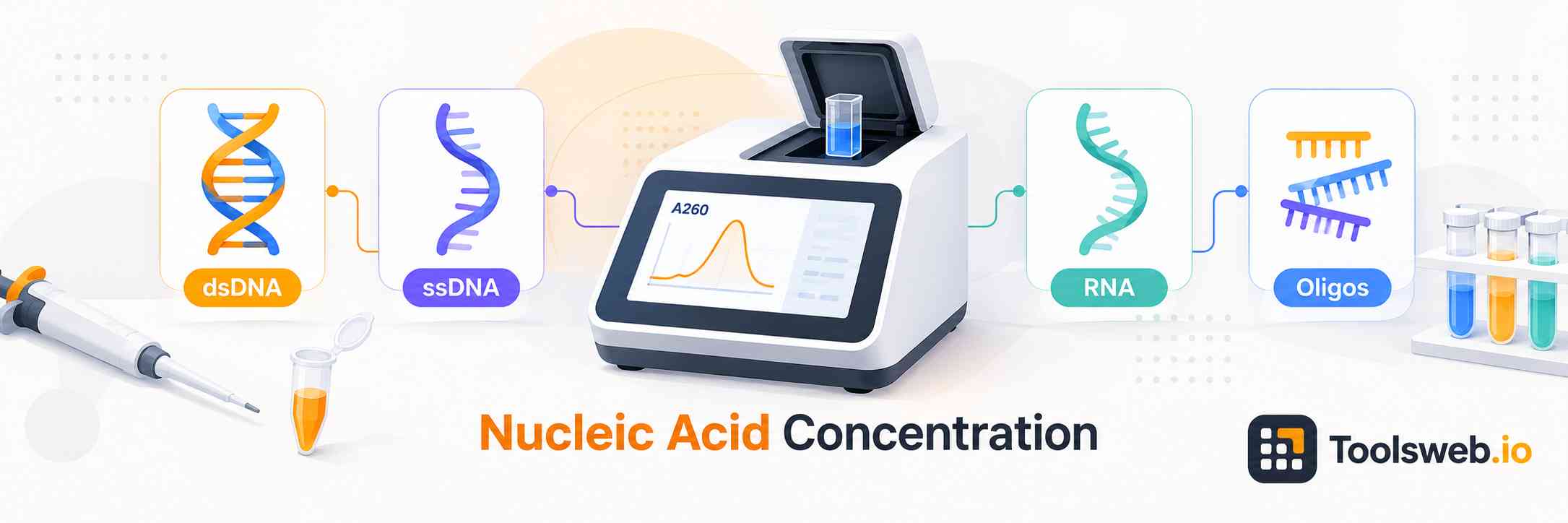
DNA Concentration Calculator for measuring nucleic acid concentration in dsDNA, ssDNA, RNA, and oligo samples.

Common DNA Concentration Calculation Mistakes

Common mistakes include choosing the wrong nucleic acid type, forgetting a dilution factor, mixing concentration with total amount, and using poor absorbance readings. Check units, sample type, volume, and instrument limits before you trust the result.

Explore Biology Calculators

Explore biology calculators for genetics, cells, organisms, and other biological calculations.

Frequently Asked Questions

These answers explain calculation accuracy, A260 readings, molecular weight, purity ratios, sample volume, sequence assumptions, and data handling.