Decimal to Octal Converter

Our Decimal to Octal Converter changes base 10 numbers into base 8 values instantly. Learn the steps, check examples, use the table, and copy results.
From
Text—
Binary—
Hexadecimal—
Decimal—
Octal—
ASCII Codes—
Recent
Nothing here yetYour recent activity will appear here

What Is the Decimal Number System?

The decimal number system uses base 10. It has ten digits, 0 through 9, and each place shows a power of 10. We use decimal numbers for everyday counting, money, and measurements.

What Is the Octal Number System?

The octal number system uses base 8. It has eight digits, 0 through 7, and each place shows a power of 8. Octal often appears in computing and number system lessons.
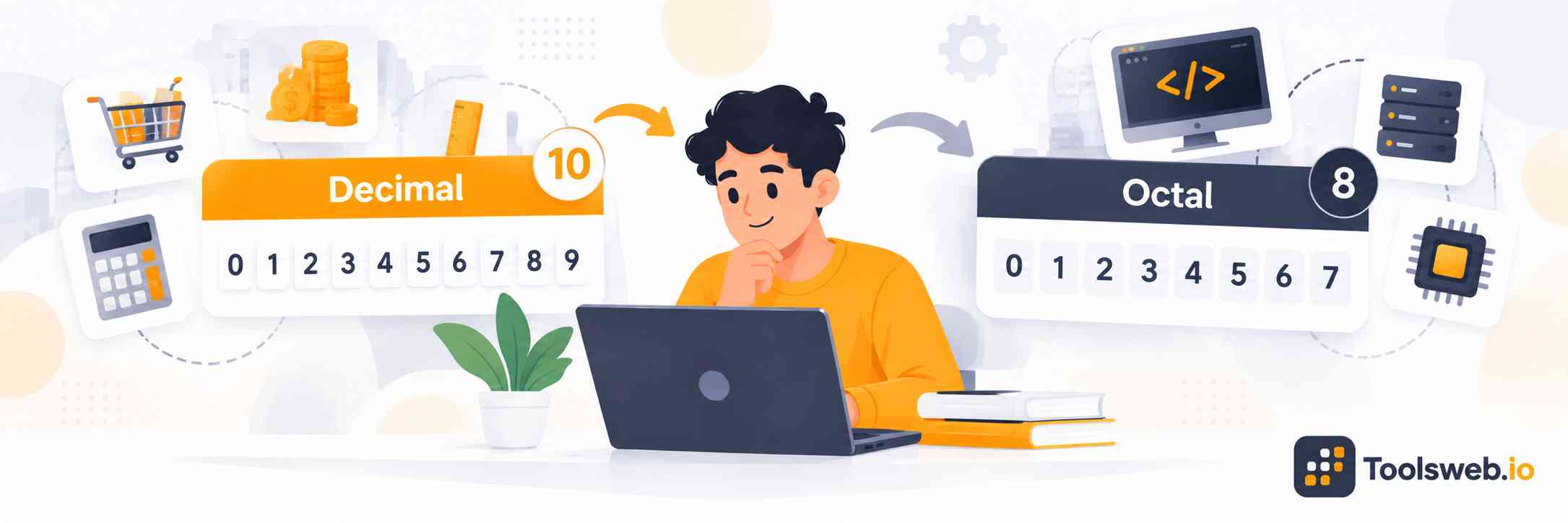
Decimal to Octal Converter showing decimal numbers converted from base 10 to octal values.

How can you use our Decimal to Octal Converter?

Our Decimal to Octal Converter quickly changes a decimal number into its matching octal value. Enter a number, view the result, and copy it for homework, coding, or study.

Step 1

Enter Your Decimal Number

Type or paste the decimal number you want to convert.

Step 2

View Octal Result

Get the octal value instantly from your decimal number.

Step 3

Copy Result

Copy the converted octal value for future use.

How to Convert Decimal to Octal Manually

To convert a decimal number to octal, divide it by 8 and record each remainder. Keep dividing the quotient until it reaches 0. Then read the remainders upward. Formula: n10=q×8+rn_{10} = q \times 8 + r.

Step by step Guide

  1. Divide the decimal number by 8.
  2. Write down the remainder.
  3. Divide the quotient by 8.
  4. Repeat until the quotient becomes 0.
  5. Read the remainders from bottom to top.

Practical Example

Convert 25 to octal. 25÷8=325 \div 8 = 3 remainder 11. Next, 3÷8=03 \div 8 = 0 remainder 33. Read upward: 31831_8. Therefore, 2510=31825_{10} = 31_8.

Decimal to Octal conversion table

Decimal

Octal

0

0

1

1

2

2

3

3

4

4

5

5

6

6

7

7

8

10

9

11

10

12

11

13

12

14

13

15

14

16

15

17

16

20

Note: Octal uses digits 0 through 7 only. If your answer contains 8 or 9, repeat the division and check every remainder before using the result.

Common Mistakes When Converting Decimal to Octal

Common errors include using 8 or 9 as an octal digit, forgetting a remainder, or reading remainders in the wrong order. Always divide by 8, keep every remainder, and read the final remainders from bottom to top. Then verify the result by converting it back to decimal.

Frequently Asked Questions

These FAQs explain the octal base, common uses, simple conversions, valid digits, and ways to convert decimal numbers by hand.