DNA Concentration Calculator
Calculate DNA/RNA concentration, total yield, purity ratios (A260/A280, A260/A230), and molarity.
Concentration
50 ng/µL
= 50 µg/mL (0.05 mg/mL)
Total Nucleic Acid Yield
2.5 µg
Total mass in 50 µL elution volume
Purity (A₂₆₀ / A₂₈₀)
1.82
Pure DNA (~1.80)
Sample concentration is 50 ng/µL (2.5 µg total in 50 µL). A₂₆₀/A₂₈₀ = 1.82.
How can you use our DNA Concentration Calculator?
Our DNA Concentration Calculator quickly calculates nucleic acid concentration, total yield, purity ratios, and molarity.
Step 1
Enter Your Sample Data
Enter the absorbance values, dilution factor, and sample volume.
Step 2
Choose Nucleic Acid Type
Select dsDNA, ssDNA, RNA, or oligo for the appropriate calculation.
Step 3
View Concentration Results
Get the concentration, total nucleic acid yield, and purity ratio instantly.
What Does the DNA Concentration Calculator Calculate?
The calculator turns absorbance, dilution, and sample data into useful concentration, yield, purity, and molarity results.
DNA Concentration
Find DNA concentration from absorbance and the selected nucleic acid type. The calculator applies the matching conversion factor.
Total Nucleic Acid Yield
Estimate total nucleic acid yield from concentration and sample volume. This shows how much DNA or RNA your sample contains.
A260/A280 Purity Ratio
Compare A260 with A280 to estimate DNA purity. The ratio can help reveal protein or other absorbance affecting sample quality.
A260/A230 Purity Ratio
Compare A260 with A230 to check for possible salts, solvents, and other contaminants that may affect nucleic acid quality.
DNA or RNA Molarity
Convert DNA or RNA concentration into molarity when you know the molecular weight or sequence length of the sample.
How to calculate DNA Concentration manually
You can estimate DNA concentration from an A260 reading by using the correct factor and dilution value. For dsDNA, a common factor is 50 µg/mL per A260.FormulaHere, is concentration, is the nucleic acid factor, and is the dilution factor. For dsDNA, .Step by step guide- Record the A260 reading.
- Select the correct nucleic acid type.
- Use its matching A260 factor.
- Multiply by the dilution factor.
- Report the result in ng/µL.
How to Calculate DNA Molarity
DNA molarity tells you the amount of DNA in moles within a given volume. You need concentration and molecular weight to calculate it.FormulaHere, is DNA concentration in ng/µL and is molecular weight in g/mol. For dsDNA:Step by step guide- Record DNA concentration in ng/µL.
- Find DNA length in base pairs.
- Calculate molecular weight.
- Divide by molecular weight.
- Report the result in nM.
How to Calculate DNA Purity
DNA purity uses absorbance ratios to check whether other substances may affect your sample. A260/A280 and A260/A230 provide two useful checks.FormulaStep by step guide- Record A260, A280, and A230.
- Divide A260 by A280.
- Divide A260 by A230.
- Compare the ratios with suitable DNA quality ranges.
- Recheck unusual results before using the sample.
What Affects DNA Concentration Measurement Accuracy?
Reliable DNA concentration results depend on sample quality, absorbance readings, dilution, path length, and the selected nucleic acid type.
Spectrophotometer and Path Length
A spectrophotometer measures absorbance through a set path length. A 1 cm path length is common for standard measurements.
Sample Dilution
A dilution changes measured concentration. Enter the correct dilution factor so the calculator can estimate the original sample concentration.
Contaminants
Proteins, phenol, salts, and other substances can affect absorbance. Poorly dissolved or impure DNA can reduce result reliability.
Very Low DNA Concentrations
Very low DNA levels can approach an instrument's detection limit. Small reading errors can then cause larger concentration errors.
Incorrect Nucleic Acid Type
Choose the correct sample type because dsDNA, ssDNA, RNA, and oligos can use different conversion factors or molecular weights.
Inaccurate Absorbance Measurements
Use a reliable absorbance reading within your instrument's useful range. Wrong readings can produce incorrect concentration and purity results.
DNA Concentration Factors for dsDNA, ssDNA, RNA, and Oligos
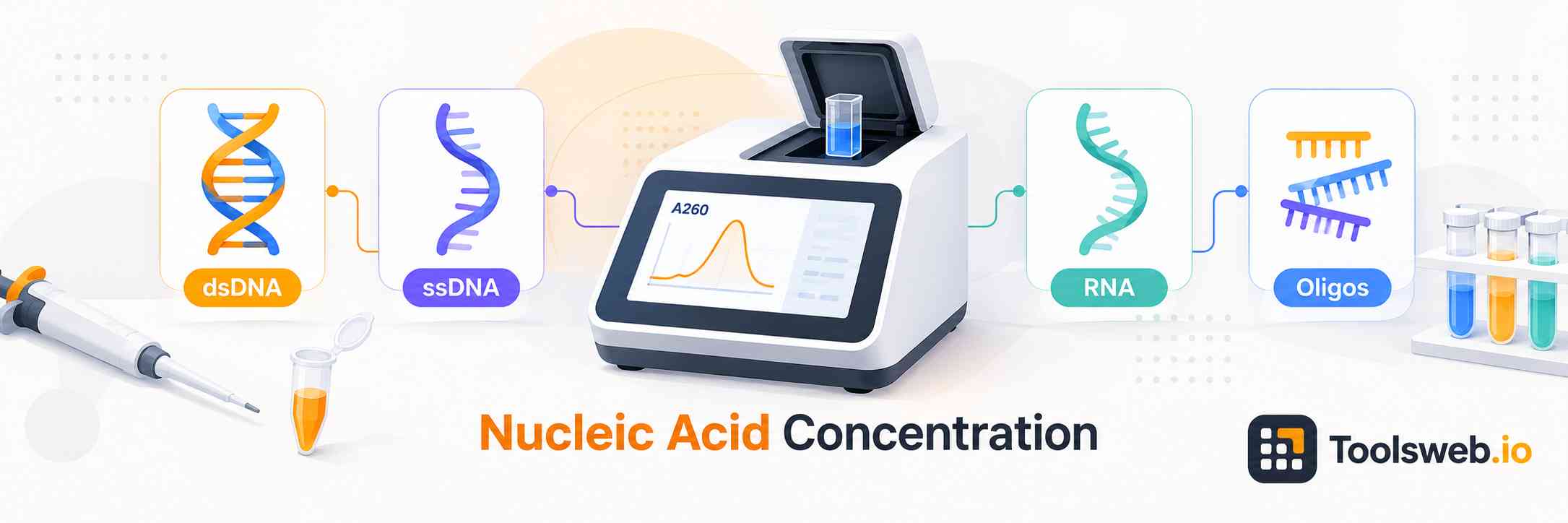
A260 conversion factors differ by nucleic acid type. Use the correct factor for dsDNA, ssDNA, RNA, or oligos, and keep the sample assumptions consistent.| Nucleic Acid Type | A260 Conversion Factor | Molecular Weight Basis | Common Use |
|---|---|---|---|
| dsDNA | 50 µg/mL per A260 | About 660 g/mol per bp | Plasmids, PCR products, DNA fragments |
| ssDNA | 33 µg/mL per A260 | About 330 g/mol per nucleotide | Single stranded DNA and oligos |
| RNA | 40 µg/mL per A260 | Sample dependent | RNA samples |
| Oligos | Sequence dependent | Sequence based | Primers and short DNA strands |
Common DNA Concentration Calculation Mistakes
Common mistakes include choosing the wrong nucleic acid type, forgetting a dilution factor, mixing concentration with total amount, and using poor absorbance readings. Check units, sample type, volume, and instrument limits before you trust the result.
Explore Biology Calculators
Explore biology calculators for genetics, cells, organisms, and other biological calculations.
Frequently Asked Questions
These answers explain calculation accuracy, A260 readings, molecular weight, purity ratios, sample volume, sequence assumptions, and data handling.