Text to Binary Converter

Our Text to Binary Converter changes text into binary code using character values. Convert letters, numbers, spaces, and symbols, then copy the result for study or projects.
From
Text—
Binary—
Hexadecimal—
Decimal—
Octal—
ASCII Codes—
Recent
Nothing here yetYour recent activity will appear here

What Is ASCII Text?

ASCII stands for American Standard Code for Information Interchange. It assigns numbers to common English letters, numbers, and symbols. Computers can represent these values with binary digits and store them as data. This helps text work across many basic computer systems.

What Is Binary System?

The binary system uses only 0 and 1. Computers use these two digits to represent data. Each digit is a bit, while eight bits form one byte. Binary is also called base 2. Each place represents a power of 2, such as 1, 2, 4, 8, and 16.
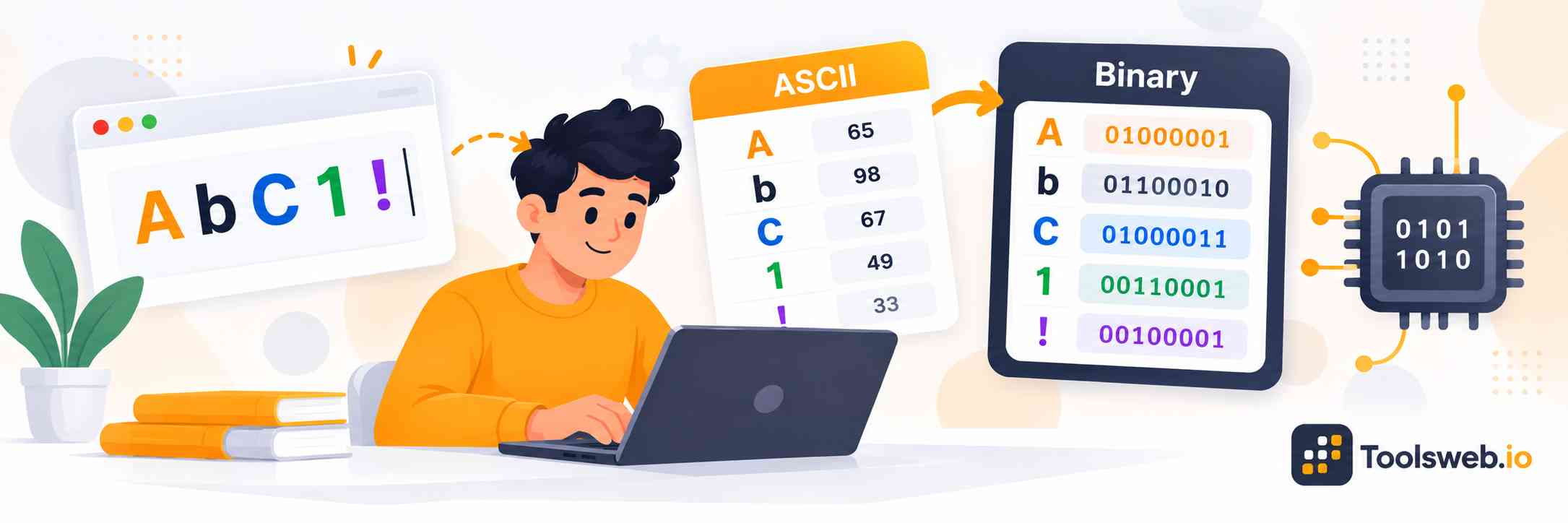
Text to Binary Converter showing text characters, ASCII values, binary codes, and digital conversion process.

How can you use our Text to Binary Converter?

Our Text to Binary Converter quickly changes text into binary values. Enter or paste text, view the binary output, and copy it for homework, practice, or coding projects. It saves time when you need clear binary code without doing each calculation by hand.

Step 1

Enter Your Text

Type or paste the text you want to convert.

Step 2

View Binary Result

Get the binary value instantly from your text.

Step 3

Copy Result

Copy the converted binary value for future use.

How to Convert Text to Binary Manually

Convert text to binary by finding each character’s ASCII value, then changing that value into binary. Use decimalvaluedecimal value and binaryvaluebinary value.

Formula

For eight-bit output, add leading zeros when needed.

Step by step Guide

  1. Choose A.
  2. Find its ASCII value. A equals 65.
  3. Convert 65 to binary: 01000001.
  4. Repeat for each character.
  5. Keep the binary groups in order.

Practical Example

CAT uses C = 67, A = 65, and T = 84. Their binary values are 01000011, 01000001, and 01010100. So, CAT becomes 01000011 01000001 01010100.

Text to Binary conversion table

Character

ASCII Decimal

Binary

A

65

01000001

B

66

01000010

C

67

01000011

a

97

01100001

b

98

01100010

c

99

01100011

0

48

00110000

1

49

00110001

Space

32

00100000

@

64

01000000

Note: This table uses eight-bit ASCII values. Leading zeros keep each character aligned and make binary output easier to read, compare, and copy.

Benefits of Text to Binary Conversion

Text to binary conversion helps students see how computers represent characters. It supports lessons about storage and communication.

Efficient Data Storage

Binary helps computers represent stored character data. This helps students understand how bits and bytes hold text for later use.

Compatibility

ASCII gives common English characters standard number values. Binary output helps students connect those character codes with different computer systems.

Secure Communication

Binary appears in digital communication and encryption systems. However, text-to-binary conversion alone does not encrypt information or make it secure.

Data Compression

Binary represents data in a form computers can process. Compression can reduce data size, but changing text into binary does not compress it.

Applications of Text to Binary Conversion

Text to binary conversion appears in computer science lessons and digital systems. These examples show how encoding connects with computers.

Data Storage and Retrieval Systems

Computers store text as encoded data. Binary representation helps systems record characters as bits and bytes, then retrieve that information when needed.

Network Communication Protocols

Network protocols move digital data between systems. Text can become encoded binary data before transmission, depending on the protocol and encoding used.

Cryptography and Data Encryption

Cryptography protects information with mathematical methods. Binary represents the underlying data, but simple text-to-binary conversion does not encrypt it.

Steganography

Steganography hides information inside other data. Binary values can support this process, but hiding data requires methods beyond simple text conversion.

Frequently Asked Questions