Text to Hex Converter

Use our Text to Hex Converter to turn text into hexadecimal values quickly. Learn ASCII, hex, manual conversion, code examples, common mistakes, and Unicode handling for students.
From
Text—
Binary—
Hexadecimal—
Decimal—
Octal—
ASCII Codes—
Recent
Nothing here yetYour recent activity will appear here

What Is ASCII Text?

ASCII is a character code system for letters, numbers, and symbols. It gives each character a number. For example, A has decimal value 65 and hex value 41. ASCII mainly supports basic English text and common control characters. It does not cover every language or emoji.

What Is Hexadecimal?

Hexadecimal, or hex, is a base-16 number system. It uses digits 0 to 9 and letters A to F. Each hex digit represents four binary bits. Hex shows computer data in a shorter form that students can read. This makes hex useful for reading encoded data.
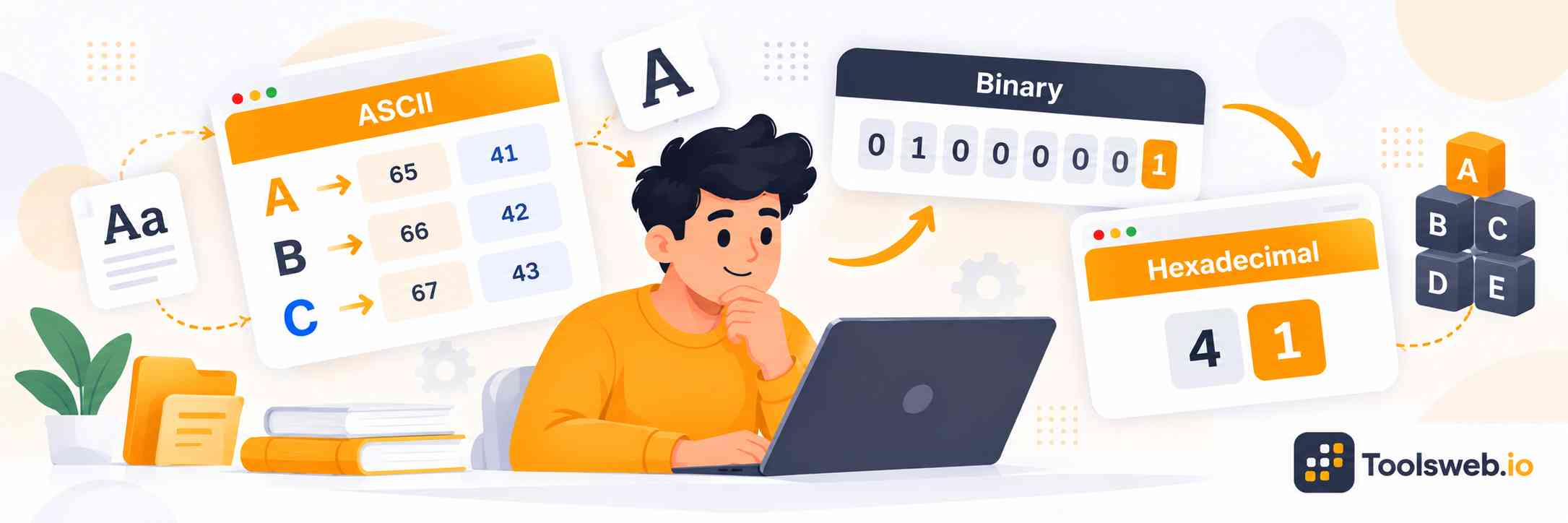
Text to Hex Converter showing ASCII characters, decimal values, binary code, and hexadecimal conversion.

How can you use our Text to Hex Converter?

Our Text to Hex Converter quickly converts text into hexadecimal values.

Step 1

Enter Your Text

Type or paste the text you want to convert.

Step 2

View Hex Result

Get the hexadecimal value instantly from your text.

Step 3

Copy Result

Copy the converted hex value for future use.

How to Convert Text to Hex Manually

To convert text manually, find the character value first, then change that value to base 16. Formula: Decimalvalue÷16=quotientandremainderDecimal value ÷ 16 = quotient and remainder. Guide:

  1. Write each character.
  2. Find its ASCII decimal value.
  3. Divide by 16.
  4. Record the remainder.
  5. Convert 10 to 15 into A to F.
  6. Read the result from last quotient to first remainder.

Practical example: A has decimal value 65. 65÷16=465 ÷ 16 = 4 remainder 11. Therefore, 65=4165 = 41 in hex. For “Hi”, H = 48 and i = 69, so the result is 486948 69.

Text to Hex conversion table

Character

ASCII Decimal

Hexadecimal

A

65

41

B

66

42

C

67

43

a

97

61

b

98

62

c

99

63

0

48

30

1

49

31

Space

32

20

!

33

21

H

72

48

e

101

65

l

108

6C

o

111

6F

Note: ASCII values show common English characters. Your result can differ for Unicode text because UTF-8 may use multiple bytes for one character.

Text to Hex Conversion through Code

You can also convert text to hexadecimal with common programming languages. Python and JavaScript provide simple ways to turn text into encoded byte values.

Python

Python can encode text as UTF-8 bytes and then convert those bytes into hexadecimal.


text = "Hello"
hex_value = text.encode("utf-8").hex()

print(hex_value)

Output:


48656c6c6f

JavaScript

JavaScript can use TextEncoder to convert text into UTF-8 bytes. You can then turn each byte into a two digit hexadecimal value.


const text = "Hello";
const bytes = new TextEncoder().encode(text);

const hex = Array.from(bytes)
.map(byte => byte.toString(16).padStart(2, "0"))
.join("");

console.log(hex);

Output:


48656c6c6f

Features of our Text to Hex Converter

Our Text to Hex Converter gives fast results through a simple input box and clear output. Paste text, convert it to hexadecimal, and copy the result. The tool helps students understand ASCII, bytes, characters, and hex values during homework, coding practice, and debugging.

Tips and Strategies for Effective Text to Hex Conversion

Check your text before converting it. Choose the right encoding for non-English characters. Keep spaces and line breaks. Compare results with an ASCII table. Use clear separators when reading many hexadecimal bytes. For Unicode text, check whether the converter uses UTF-8.

Common Text to Hex Conversion Mistakes

Common mistakes include mixing decimal and hex values, missing spaces, and treating hex as encryption. Letter case also matters. A becomes 41, while lowercase a becomes 61. Unicode text can use several bytes for one character. Check the encoding before comparing results from different tools.

Frequently Asked Questions

These FAQs explain text to hex conversion, ASCII, hexadecimal encoding, Unicode, blockchain, BOM, and common errors too.