VAT Calculator

Use our VAT Calculator to add or remove VAT from any amount, find net and gross prices, and check the VAT amount quickly with a clear result for study or business use today, anywhere.
Gross Amount
$120
Net Amount

$100

VAT Amount

$20

Rate

20%

Recent
Nothing here yetYour recent activity will appear here

What is VAT?

VAT, or Value Added Tax, is a tax added to many goods and services. A net price excludes VAT, while a gross price includes VAT. The VAT rate decides how much tax you add to the price.

GST

GST means Goods and Services Tax. It works like VAT in many countries, but each country sets its own rules and rates. Australia uses GST, while the UK and Ireland use VAT for many sales.

VAT vs. Sales Tax

VAT applies at several stages of a supply chain, while sales tax usually applies at the final sale. Eligible businesses can often recover input VAT, which makes VAT different from sales tax.
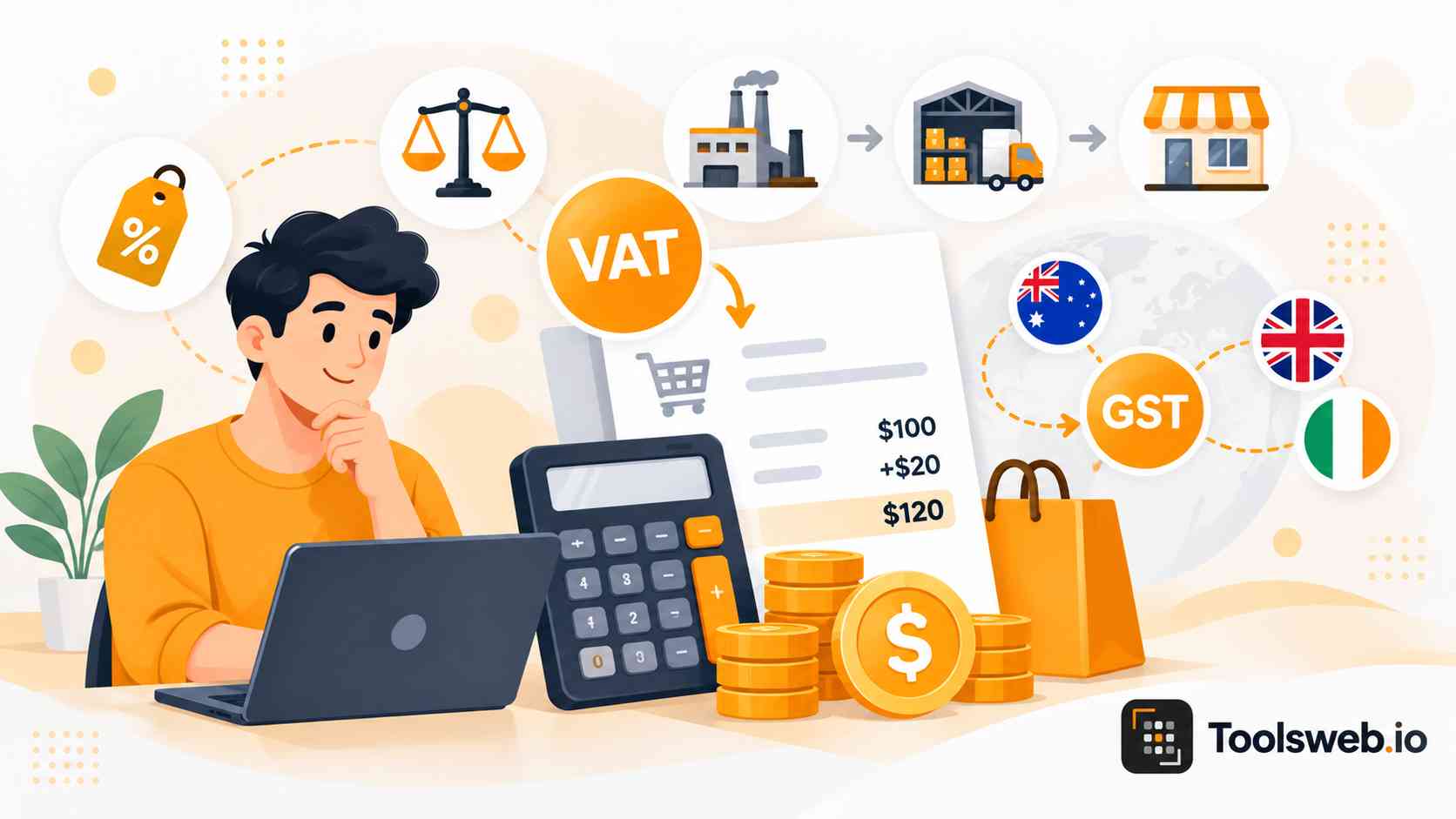
VAT Calculator showing value added tax calculations, prices, GST rates, and international tax examples.

How can you use our VAT Calculator?

Our VAT Calculator quickly adds or removes VAT from any amount. Enter a price, choose a VAT rate, select an option, and get the net price, VAT amount, and gross price instantly. Use it for study or price checks.

Step 1

Enter Your Amount

Enter the net amount and VAT rate.

Step 2

Choose VAT Option

Select whether to add or remove VAT.

Step 3

View Your Results

Get the gross amount, VAT amount, and rate instantly.

Step 4

Copy Your Result

Copy the calculated VAT details for future use.

How can you calculate VAT manually?

You can calculate VAT with a simple formula. Use the VAT rate as a decimal, such as 20% = 0.20.

Formula

VAT = Net price x VAT rate

Gross price = Net price + VAT

Step by step guide

  1. Start with the net price.
  2. Change the VAT rate to a decimal.
  3. Multiply the net price by that rate.
  4. Add the VAT to the net price.

Practical Example

For $100 at 20% VAT:

VAT = 100x0.20=100 x 0.20 = 20.

Gross price = 100+100 + 20 = $120.

To remove VAT, divide the gross price by 1.20. So, 120/1.20=120 / 1.20 = 100 net, and $20 VAT.

VAT calculation on the basis of the net price

Start with the net price before VAT. Multiply it by the VAT rate to find the tax. Then add the VAT amount to the net price.

For example, with a $500 net price and 20% VAT:

VAT = 500x0.20=500 x 0.20 = 100

Gross price = 500+500 + 100 = $600

This method works when you know the price before VAT.

VAT Calculation on the basis of the total price

Start with the total price when it already includes VAT. Divide the total by 1 plus the VAT rate to find the net price.

For example, with a $600 gross price and 20% VAT:

Net price = 600/1.20=600 / 1.20 = 500

VAT = 600−600 - 500 = $100

Global VAT Rates Compared

VAT rates vary by country and tax system. Use the correct rate for the transaction, and check official tax guidance before filing or billing.

Country / Tax System

Main Rate

Notes

United Kingdom

20% VAT

Reduced 5% and zero rates also apply to qualifying supplies.

Ireland

23% VAT

Current reduced rates include 13.5%, 9%, and 4.8%.

Australia

10% GST

Australia uses GST rather than VAT.

Canada

5% to 15% GST/HST

The rate depends on the province and place of supply.

United States

No federal VAT

State and local sales taxes use different rules.

Brazil

0.9% CBS + 0.1% IBS in 2026 test

Brazil is testing its new consumption tax system in 2026.

Note: VAT rates can change, and some goods have special rules. Australia and Canada use GST or HST, while Brazil is testing a new IBS and CBS system in 2026.

VAT Mistakes That Cost Small Businesses Thousands

Small VAT errors can become costly for a business. Use the correct VAT rate, keep valid invoices, separate expenses, and record the right tax point.

Charging the wrong VAT rate

Using the wrong VAT rate changes every invoice. Check the product, service, and current VAT rate before charging customers or filing a VAT return.

Claiming VAT without a valid invoice

You need valid VAT evidence to reclaim input VAT. Keep the correct invoice or receipt with your business records before making a VAT claim.

Mixing business and personal expenses

Personal costs do not become business costs because you paid them through the company. Separate expenses before claiming input VAT on purchases.

Relying on the wrong flat rate percentage

The Flat Rate Scheme uses sector rates. A limited cost business may need the 16.5% rate, so check your status before using another percentage.

Not understanding the time of supply (tax point)

VAT timing can depend on the tax point. Check when the supply happens, payment occurs, and the invoice is issued before recording VAT.

Not reclaiming VAT on capital purchases

Capital purchases can have special VAT rules. Check the Capital Goods Scheme and current limits before making a large VAT reclaim.

Financial Calculators

Use financial calculators for loans, interest, investments, savings, taxes, and financial planning.

Frequently Asked Questions

These VAT questions cover registration, rates, formulas, invoices, VAT recovery, flat rates, cars, and deregistration.