Atom Calculator

Use our Atom Calculator to find protons, neutrons, electrons, electron configuration, and valence electrons for any element. Get atomic weight and other key properties quickly, with clear results.

Choose from 28 elements — no guessing needed

+ = cation, − = anion

612CCarbonNeutral Atom
Protons6Z = 6
Neutrons6N = A − Z
Electrons6e⁻

Electronic Structure & Classification

Configuration[He] 2s² 2p²
Valence e⁻4
SeriesReactive NonmetalPeriod 2 · Group 14
Atomic Weight12.011 g/mol

Carbon-12 (C): Atomic number Z=6, Mass number A=12. Contains 6 protons, 6 neutrons, and 6 electrons.

What Is an Atom?

An atom is the basic unit of an element. It has a nucleus with protons and neutrons, plus electrons around the nucleus. These subatomic particles give each element its unique atomic structure.

What Are Protons, Neutrons, and Electrons?

Protons have positive charge, neutrons have no charge, and electrons have negative charge. These subatomic particles make up every atom and help determine its structure and charge.

What Is Atomic Number?

Atomic number tells you how many protons an atom has. It identifies the element and remains the same for every atom of that element. It stays fixed when electrons change.

What Is Mass Number?

Mass number equals the total protons and neutrons in an atom. It describes the particles inside the nucleus of one isotope. Carbon 13 has a mass number of 13. It helps you find neutrons.

What Is Atomic Mass or Atomic Weight?

Atomic mass gives the mass of one atom in atomic mass units. Atomic weight gives an element's average mass across its natural isotopes. These values help with chemistry calculations.

What Is an Ion?

An ion is an atom with different numbers of protons and electrons. It becomes positive or negative after losing or gaining electrons. Its atomic number stays the same. Only the electron count changes.
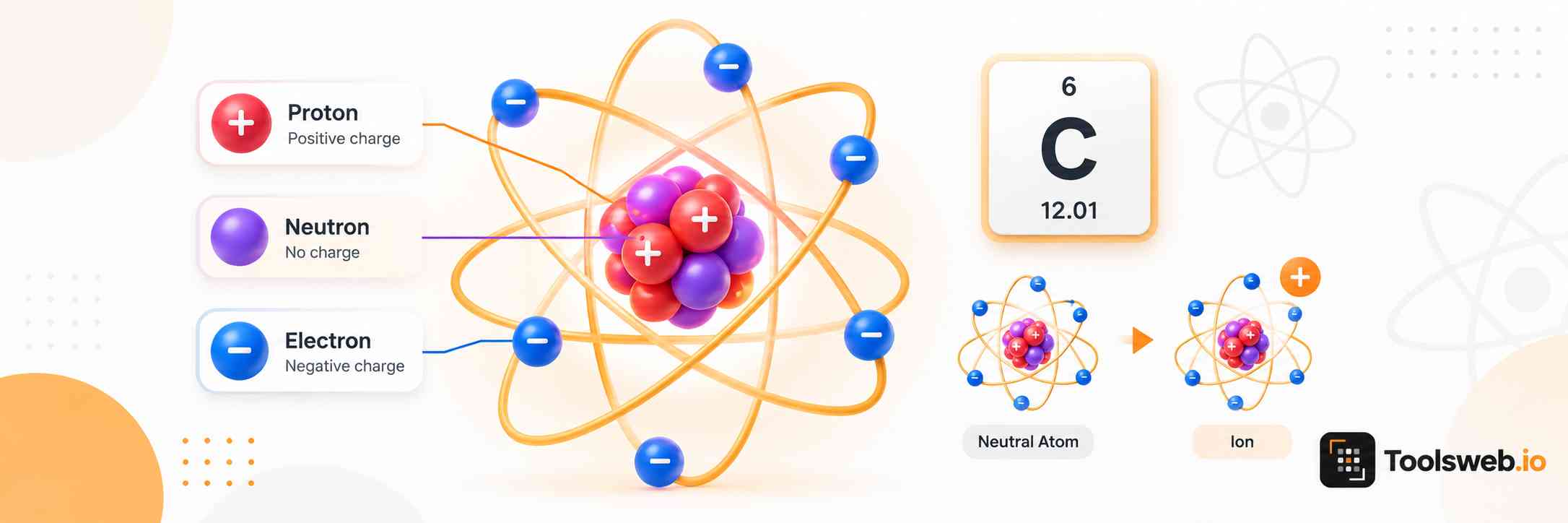
Atom Calculator showing protons, neutrons, electrons, atomic structure, and the formation of an ion.

How can you use our Atom Calculator?

Our Atom Calculator uses an element, mass number, and ion charge to quickly find protons, neutrons, electrons, and electron configuration.

Step 1

Select an Element

Choose the element you want to calculate.

Step 2

Enter Atomic Details

Enter the mass number and ion charge for the selected atom.

Step 3

View Atomic Properties

Get protons, neutrons, electrons, electron configuration, and valence electrons instantly.

What Does the Atom Calculator Calculate?

The Atom Calculator finds key atomic properties from your element, mass number, and net charge. It gives clear results for chemistry study.

Number of Protons

The proton count equals the atomic number. It identifies the element and stays unchanged when the atom becomes an ion. Protons define element identity.

Number of Neutrons

Subtract the atomic number from the mass number. The result gives the number of neutrons inside the atom's nucleus. Neutrons help set isotope mass.

Number of Electrons

A neutral atom has equal protons and electrons. An ion gains or loses electrons, so its electron count changes. Charge shows this difference.

Electron Configuration

Electron configuration shows how electrons fill energy levels and orbitals around an atom's nucleus. It helps describe electron arrangement and behavior.

Valence Electrons

Valence electrons occupy the outer energy level. They affect how an element reacts and forms bonds. Main group elements often show clear patterns.

Atomic Weight

Atomic weight represents the average mass of an element's natural isotopes. Their relative amounts determine this average. It differs from mass number.

How to Calculate Protons, Neutrons, and Electrons Manually

Use atomic number, mass number, and charge to find protons, neutrons, and electrons.

Formula

protons=atomic numberprotons = atomic\ number

neutrons=mass number−atomic numberneutrons = mass\ number - atomic\ number

electrons=atomic number−chargeelectrons = atomic\ number - charge

Step by step guide

  1. Find the element's atomic number on the periodic table.
  2. Use the mass number to find neutrons.
  3. Subtract atomic number from mass number.
  4. Use the ion charge to find electrons.

Practical Example

For sodium 23 with a +1 charge:

protons=11protons = 11

neutrons=23−11=12neutrons = 23 - 11 = 12

electrons=11−1=10electrons = 11 - 1 = 10

How to Calculate atomic mass, and atomic charge Manually

Mass number counts protons and neutrons. Atomic weight uses isotope masses and abundances. Charge compares protons and electrons.

Formula

mass number=protons+neutronsmass\ number = protons + neutrons

charge=protons−electronscharge = protons - electrons

Step by step guide

  1. Count protons to identify the element.
  2. Add protons and neutrons to get mass number.
  3. Subtract electrons from protons to get charge.
  4. Use isotope data for atomic weight.

Practical Example

For an atom with 8 protons, 8 neutrons, and 10 electrons:

mass number=8+8=16mass\ number = 8 + 8 = 16

charge=8−10=−2charge = 8 - 10 = -2

Isotopes, Ions, and Neutral Atoms

Isotopes differ in neutron count, ions differ in electron count, and neutral atoms have equal numbers of protons and electrons.

What Is an Isotope?

An isotope is an atom of the same element with a different number of neutrons. Carbon 12 and carbon 13 are common examples. They share the same protons.

What Is a Neutral Atom?

A neutral atom has equal numbers of protons and electrons. Their positive and negative charges balance, giving the atom a zero charge.

What Is a Cation?

A cation is a positive ion. It forms when an atom loses one or more electrons, leaving more protons than electrons. Its charge is positive.

What Is an Anion?

An anion is a negative ion. It forms when an atom gains one or more electrons, giving it more electrons than protons. Its charge is negative.

Electron Configuration and Valence Electrons

Electron configuration describes electron placement in orbitals. Valence electrons occupy the outer level and help control chemical reactions and bonding.

What Is Electron Configuration?

Electron configuration shows where an atom's electrons sit in energy levels and orbitals around its nucleus. It describes the electron arrangement.

How Are Electrons Distributed in Orbitals?

Electrons fill orbitals from lower to higher energy levels. Each orbital holds a limited number of electrons based on its type.

How Do You Find Valence Electrons?

Find the electrons in the outermost occupied energy level. For many main group elements, the periodic table helps you identify them.

Common Mistakes When Calculating Atomic Properties

Common mistakes include confusing atomic mass with mass number or using the wrong charge sign. Another mistake is forgetting that atomic number equals protons. Check the element, formula, and charge before accepting your result. Check the periodic table before calculating.

Explore Chemistry Calculators

Find chemistry calculators for reactions, solutions, molarity, stoichiometry, and more.

Frequently Asked Questions

These FAQs answer common questions about atoms, atomic number, mass number, charge, particles, density, isotopes, and results.