Average Atomic Mass Calculator

Use the Average Atomic Mass Calculator to find an element's weighted average mass from isotope masses and abundances. Learn the formula, compare isotopes, and check your result.
Weighted Average Atomic Mass
35.4529 amu

Isotope Contribution Breakdown

IsotopeExact MassAbundanceFractionalWeighted Mass
³⁵Cl34.96975.77%0.757726.496 amu
³⁷Cl36.96624.23%0.24238.9569 amu

Average Atomic Mass = (34.969 × 0.7577) + (36.966 × 0.2423) = 35.4529 amu (u)

What is an Average Atomic Mass?

Average atomic mass is the weighted average of an element's isotope masses. More abundant isotopes affect the result more. Use isotope mass and fractional abundance in this formula: A=Σ(mf)A = \Sigma(mf).

Equation:

A=(m1×f1)+(m2×f2)+...A = (m_1 \times f_1) + (m_2 \times f_2) + ...

Here, AA is average atomic mass, mm is isotope mass, and ff is fractional abundance.

How can you use our Average Atomic Mass Calculator?

Our Average Atomic Mass Calculator quickly calculates the weighted average atomic mass of an element from isotope masses and abundances.

Step 1

Enter Your Element

Enter the name of the element you want to calculate.

Step 2

Add Isotope Data

Enter the exact mass and natural abundance for each isotope.

Step 3

View Average Atomic Mass

Get the weighted average atomic mass and isotope contribution breakdown instantly.

How to calculate Average Atomic Mass manually

Use A=(m1f1)+(m2f2)+...A = (m_1f_1) + (m_2f_2) + ..., where mm is isotope mass and ff is fractional abundance.

Formula

A=Σ(m×f)A = \Sigma(m \times f)

Step by step guide

  1. List each isotope mass and abundance.
  2. Divide each percentage by 100.
  3. Multiply each isotope mass by its fractional abundance.
  4. Add the isotope contributions.
  5. Round the final answer correctly.

Practical Example

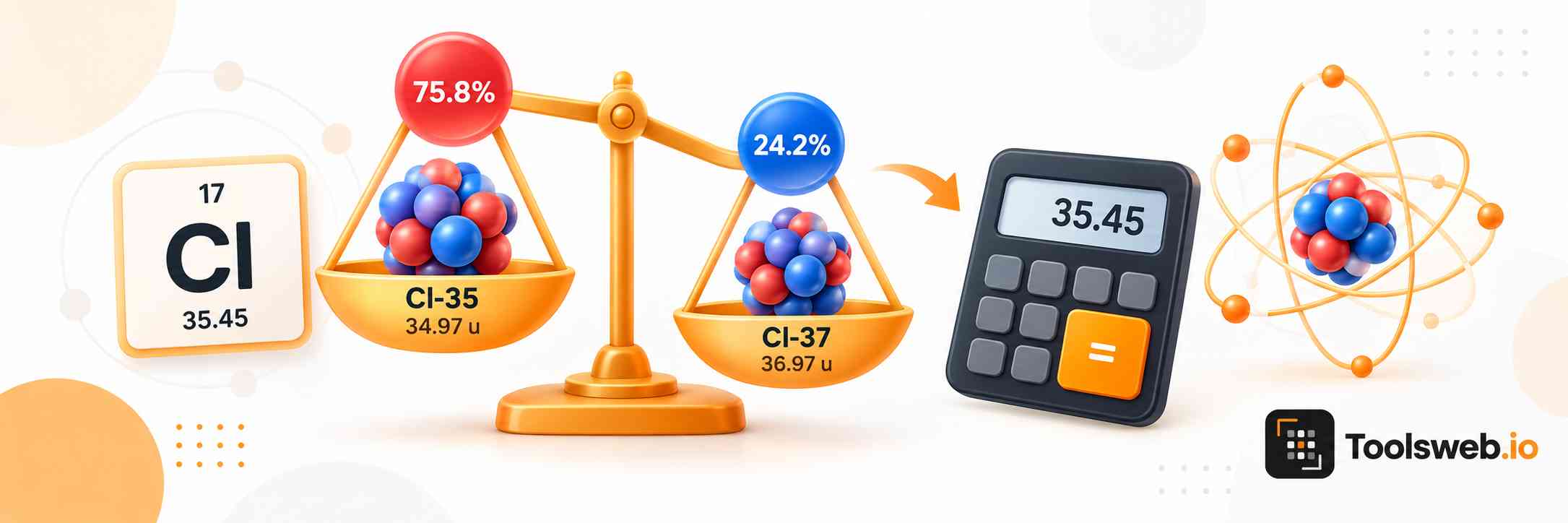
Chlorine has 35Cl^{35}Cl at 34.969 u and 75.78%, plus 37Cl^{37}Cl at 36.966 u and 24.22%. Calculate A=(34.969×0.7578)+(36.966×0.2422)A = (34.969 \times 0.7578) + (36.966 \times 0.2422). The average is about 35.45 u.

Average Atomic Masses Table of some elements

Element

Symbol

Average Atomic Mass

Hydrogen

H

1.008 u

Helium

He

4.003 u

Lithium

Li

6.94 u

Carbon

C

12.011 u

Nitrogen

N

14.007 u

Oxygen

O

15.999 u

Fluorine

F

18.998 u

Neon

Ne

20.180 u

Sodium

Na

22.990 u

Magnesium

Mg

24.305 u

Aluminum

Al

26.982 u

Silicon

Si

28.085 u

Phosphorus

P

30.974 u

Sulfur

S

32.06 u

Chlorine

Cl

35.45 u

Potassium

K

39.098 u

Calcium

Ca

40.078 u

Iron

Fe

55.845 u

Copper

Cu

63.546 u

Zinc

Zn

65.38 u

Isotope Abundance and Average Atomic Mass

Isotope abundance tells you how common each isotope is in a natural sample. The calculator uses this value to weight each isotope mass.

What Is Isotopic Abundance?

Isotopic abundance shows the percentage of an element found as a specific isotope. Chlorine has common chlorine-35 and chlorine-37 isotopes.

What Is Fractional Abundance?

Fractional abundance changes a percentage into a decimal. Divide the percentage by 100, then use it in the weighted average formula.

How Does Isotope Abundance Affect the Average Atomic Mass?

A more abundant isotope has a greater effect on average atomic mass. Its mass gets a larger weight in the weighted average calculation.

Why Does the Average Usually Fall Between Isotope Masses?

The weighted average usually sits between the isotope masses. It moves closer to the mass of the isotope with higher abundance.

Average Atomic Mass Calculator showing chlorine isotopes, isotope abundances, and weighted average atomic mass.

Term

Meaning

Example / Key Point

Average Atomic Mass

Weighted average of naturally occurring isotope masses

Chlorine ≈ 35.45 u

Atomic Mass

Mass of a particular atom or isotope

³⁵Cl ≈ 34.969 u

Mass Number

Total number of protons and neutrons in an isotope

³⁵Cl has a mass number of 35

Relative Atomic Mass

Dimensionless ratio comparing an atom's mass with the defined atomic mass standard

Used to express relative atomic masses

Molar Mass

Mass of one mole of a substance

Chlorine atoms ≈ 35.45 g/mol

Common Mistakes When Calculating Average Atomic Mass

Common mistakes include using percentage abundance instead of fractional abundance, adding isotope masses without weights, and rounding too early. Always check that abundances total about 100% and keep enough digits during the calculation.

Explore Chemistry Calculators

Find chemistry calculators for reactions, solutions, molarity, stoichiometry, and more.

Frequently Asked Questions

These answers explain average atomic mass, isotope abundance, units, unknown values, and common chemistry questions students ask.