Bond Order Calculator

Use our Bond Order Calculator to find bond order from molecular orbital or Lewis structure data, then understand bond strength, bond length, magnetic properties, and resonance.
Presets:
Bond Order
3

Triple Bond (Exceptionally Strong & Short)

Magnetic Property
Diamagnetic

Diamagnetic (all electrons paired)

Bond Strength / Dissociation
Triple bond (~950–1100 kJ/mol)

Bond Order = (Nb - Na) / 2 = (10 - 4) / 2 = 3

Calculated Bond Order is 3. Molecule is characterized as Triple Bond (Exceptionally Strong & Short) and Diamagnetic (all electrons paired).

What is a Bond Order in Molecular Orbital Theory?

Bond order shows the strength and stability of a chemical bond. It compares bonding electrons with antibonding electrons in molecular orbitals.

A higher bond order usually means a stronger and shorter bond. A bond order of zero means no stable conventional bond forms.

Bond Order in Molecular Orbital Theory

Molecular orbital theory uses bonding and antibonding electrons to calculate bond order. The formula subtracts antibonding electrons from bonding electrons, then divides by two.

BO=(Nb−Na)/2BO = (N_b - N_a) / 2

Here, NbN_b means bonding electrons and NaN_a means antibonding electrons.

How can you use our Bond Order Calculator?

Our Bond Order Calculator quickly calculates bond order, bond strength, and magnetic properties from molecular orbital or Lewis structure data.

Step 1

Enter Bonding Electrons

Enter the number of bonding and antibonding electrons for your molecule.

Step 2

Choose a Calculation Method

Select Molecular Orbital Theory or Lewis Resonance Structure for your calculation.

Step 3

View Bond Properties

Get the bond order, magnetic property, and estimated bond strength instantly.

How to Calculate Bond Order Using Molecular Orbital Theory

Molecular orbital theory calculates bond order from bonding and antibonding electrons. Use this formula: BO=(Nb−Na)/2BO = (N_b - N_a) / 2.

Formula

BO=(Nb−Na)/2BO = (N_b - N_a) / 2

Step by step guide

  1. Count the bonding electrons.
  2. Count the antibonding electrons.
  3. Subtract NaN_a from NbN_b.
  4. Divide the result by 22.

Practical Example

For N2N_2, use 10 bonding electrons and 4 antibonding electrons.

BO=(10−4)/2=3BO = (10 - 4) / 2 = 3

Therefore, N2N_2 has a triple bond and strong bond stability.

How to Find Bond Order From a Lewis Structure

Lewis structures show bonds as shared electron pairs. You can find bond order by counting the bonds between two atoms.

Single, Double, and Triple Bonds

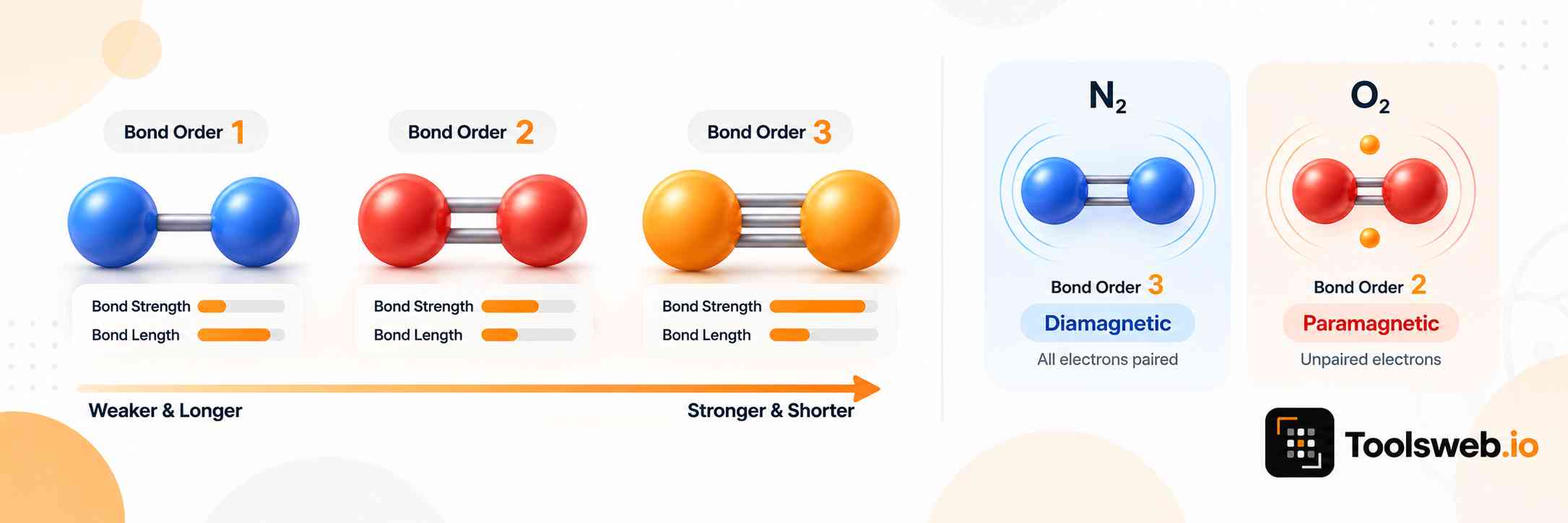
A single bond has a bond order of 1. A double bond has a bond order of 2. A triple bond has a bond order of 3.

Step by Step Method

  1. Draw the Lewis structure.
  2. Find the bond between the atoms.
  3. Count the shared bond pairs.
  4. Assign the bond order from the bond type.

Practical Examples

For H2H_2, the H to H bond is single, so BO=1BO = 1. For O2O_2, the O to O bond is double, so BO=2BO = 2.

How to Calculate Bond Order in Resonance Structures

Resonance structures can spread a bond across several equivalent positions. This can create a fractional average bond order.

Resonance Bond Order Formula

Use the total bond order across equivalent bonds: Average BO=Total bond order units/Number of equivalent bondsAverage\ BO = Total\ bond\ order\ units / Number\ of\ equivalent\ bonds.

Step by Step Method

  1. Draw all valid resonance structures.
  2. Add the bond order units.
  3. Count equivalent bonds.
  4. Divide total units by equivalent bonds.

Practical Example

In ozone, O3O_3, one double bond and one single bond spread across two equivalent O to O bonds.

Average BO=(2+1)/2=1.5Average\ BO = (2 + 1) / 2 = 1.5

Bond Order, Bond Strength, and Bond Length

Bond order helps compare chemical bond strength and length. Higher bond order usually means stronger bonds with shorter bond lengths.

Bond Order and Magnetic Properties

Bond order and electron arrangement can help describe molecular magnetic properties. Unpaired electrons cause paramagnetism, while paired electrons cause diamagnetism.

Diamagnetic Molecules

Diamagnetic molecules have all electrons paired. For example, N2N_2 has bond order 3 and shows diamagnetic behavior.

Paramagnetic Molecules

Paramagnetic molecules contain one or more unpaired electrons. For example, O2O_2 has bond order 2 and shows paramagnetic behavior.

Bond Order Calculator showing single, double, and triple bonds with bond strength, bond length, and molecular examples.

Bond Order Examples for Common Molecules and Ions

Molecule or Ion

Bond

Bond Order

Magnetic Property

H₂

H to H

1

Diamagnetic

He₂

He to He

0

Not stable as a conventional molecule

N₂

N triple bond N

3

Diamagnetic

O₂

O to O

2

Paramagnetic

O₂⁺

O to O

2.5

Paramagnetic

O₂⁻

O to O

1.5

Paramagnetic

O₂²⁻

O to O

1

Diamagnetic

CO

C to O

3

Diamagnetic

NO

N to O

2.5

Paramagnetic

O₃

O to O

1.5 average

Paramagonal

Common Bond Order Mistakes

Common mistakes include counting the wrong electrons, forgetting to divide by two, or ignoring resonance. Always check bonding electrons, antibonding electrons, and the correct calculation method.

Explore Chemistry Calculators

Find chemistry calculators for reactions, solutions, molarity, stoichiometry, and more.

Frequently Asked Questions

These answers explain fractional bond order, resonance, MO theory, bond strength, magnetic properties, and common molecule examples.