What is an Atomic Mass?
Atomic mass is the mass of one atom, based mainly on its protons and neutrons. It uses atomic mass units (). Each isotope has its own atomic mass.
Hill System Formula: C6H12O6 (24 total atoms)
| Element | Atoms | Atomic Wt | Subtotal Mass | Mass % |
|---|---|---|---|---|
| Carbon (C) | 6 | 12.011 | 72.066 g/mol | 40% |
| Hydrogen (H) | 12 | 1.008 | 12.096 g/mol | 6.71% |
| Oxygen (O) | 6 | 15.999 | 95.994 g/mol | 53.28% |
C6H12O6 has a molar mass of 180.156 g/mol (24 total atoms across 3 elements).
Atomic mass is the mass of one atom, based mainly on its protons and neutrons. It uses atomic mass units (). Each isotope has its own atomic mass.
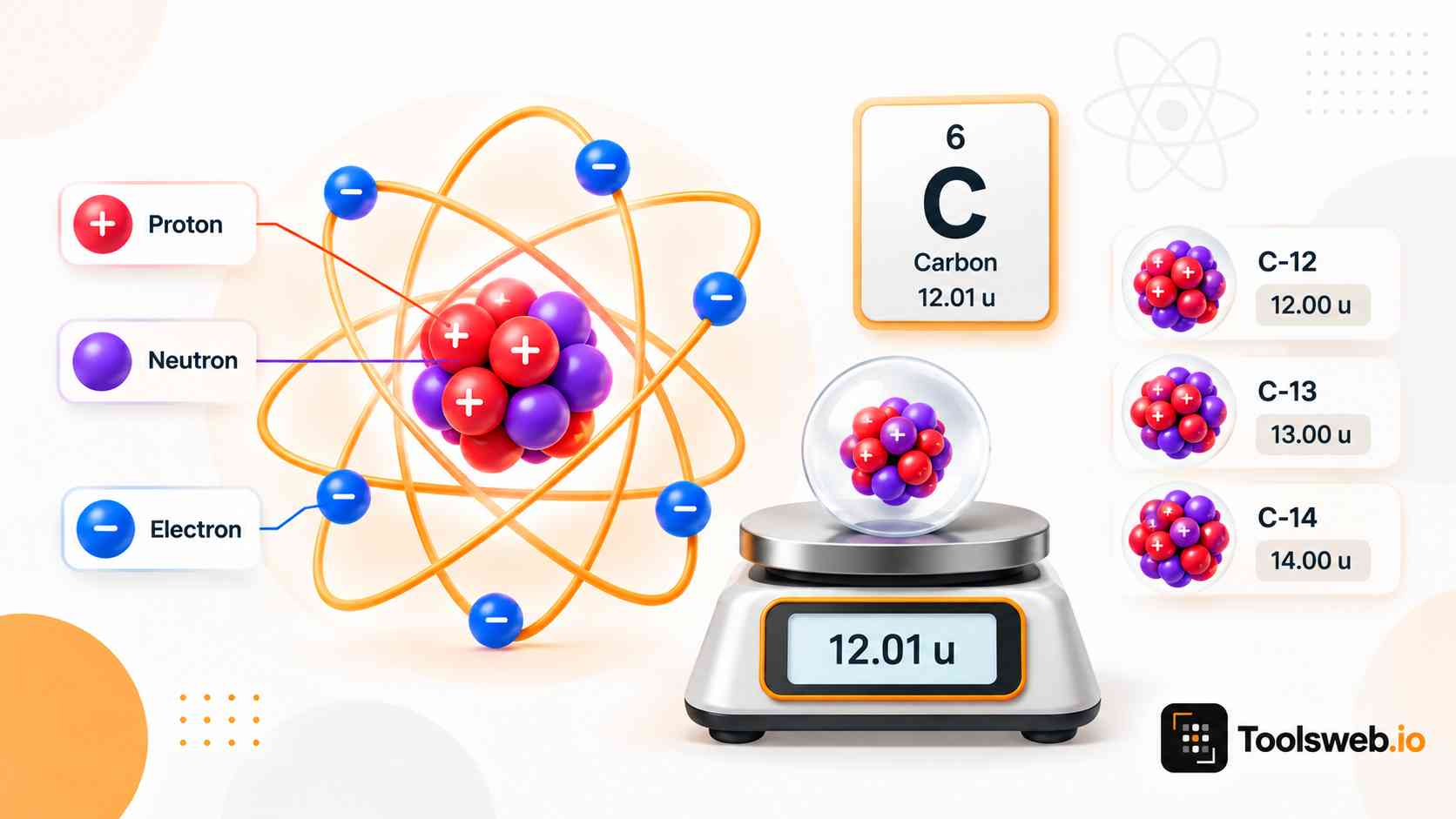
Our Atomic Mass Calculator quickly calculates the total molar mass and elemental mass percentage of a chemical formula.
Enter the chemical formula you want to calculate.
Get the total molar mass or molecular weight of the compound instantly.
View each element's mass contribution and percentage composition.
Enter the chemical formula you want to calculate.
Get the total molar mass or molecular weight of the compound instantly.
View each element's mass contribution and percentage composition.
An Atomic Mass Calculator helps you find molecular weight, molar mass, elemental mass percentage, and each element's mass contribution from a formula.
Enter a formula to find molecular weight. For , calculate . The result gives the compound's mass per mole.
The calculator adds atomic weights for each atom in a formula. For , calculate . This gives sodium chloride's molar mass.
Find each element's share of total mass. Use . This gives each element's mass percentage.
See each element's mass contribution in a compound. This shows which elements add the most to total molar mass and helps you check the formula.
For formulas with parentheses, multiply every atom inside the group by the outside subscript. For , the applies to and .
For hydrated compounds, include the water molecules after the dot. For , calculate and five water molecules.
You can calculate average atomic mass by multiplying each isotope mass by its fractional abundance. Then add all isotope contributions. Use , where is isotope mass and is fractional abundance.
Formula
Step by step guide
Practical Example
For chlorine, use 34.969 u at 75.78% and 36.966 u at 24.22%.
.
These common chemical formulas provide quick reference values for chemistry homework, lab work, and formula checks. Values use standard atomic weights.
Chemical Formula | Compound | Molar Mass |
|---|---|---|
Water | 18.015 g/mol | |
Carbon dioxide | 44.009 g/mol | |
Sodium chloride | 58.44 g/mol | |
Ammonia | 17.031 g/mol | |
Methane | 16.043 g/mol | |
Calcium carbonate | 100.086 g/mol | |
Glucose | 180.156 g/mol |
Note: Molar masses can vary slightly with atomic weight values and rounding. Match your course or lab reference when a specific value is required.
Common Mistakes When Calculating Molar Mass
Common errors include wrong atomic weights, missed subscripts, missing parentheses, or incorrect sums. Always check each element, atom count, formula, and unit before accepting the molar mass. These small mistakes can change the final answer.
Atomic mass, atomic weight, mass number, and molar mass are related but describe different measurements. The table below highlights their definitions, units, and how they are used in chemistry.
Term | What It Means | Unit | How It Is Determined | Example |
|---|---|---|---|---|
Atomic Mass | The mass of a single atom, usually expressed relative to 1/12 of the mass of a carbon 12 atom. | u (amu) | Depends on the specific isotope | Carbon 12 has an atomic mass of 12 u |
Atomic Weight | The weighted average of the atomic masses of an element's naturally occurring isotopes. | u (often reported as a relative value) | Based on isotope abundances | Carbon has an atomic weight of about 12.011 u |
Mass Number | The total number of protons and neutrons in the nucleus of a specific isotope. | No unit | Protons + neutrons | Carbon 12 has a mass number of 12 |
Molar Mass | The mass of one mole of atoms, molecules, or compounds. | g/mol | Sum of the atomic weights in the chemical formula | C₆H₁₂O₆ has a molar mass of 180.156 g/mol |
Atomic mass refers to the mass of one specific atom or isotope. Atomic weight is the weighted average of an element's naturally occurring isotopes. Mass number simply counts the protons and neutrons in one isotope. Molar mass tells you how many grams one mole of a substance weighs.
Find chemistry calculators for reactions, solutions, molarity, stoichiometry, and more.
These FAQs answer student questions about atomic mass, neutrons, average atomic mass, mass number, carbon 12, and percentage composition.