Electronegativity Calculator

Our Electronegativity Calculator finds electronegativity differences, bond type, polarity, and ionic character using clear chemistry formulas and element values.
Popular Pairs:
Electronegativity Difference (ΔEN)
1.24

|2.2 − 3.44| (Pauling scale)

Predicted Bond Type
Polar Covalent

Polar Covalent (0.4 ≤ ΔEN < 1.7)

Ionic Character & Dipole
31.9% Ionic

H (δ⁺) → O (δ⁻)

The H–O bond has an electronegativity difference ΔEN = 1.24. It is classified as Polar Covalent (Unequal electron density) with ~31.9% ionic character.

What is an Electronegativity?

Electronegativity shows how strongly an atom attracts shared electrons in a chemical bond. A higher value means stronger attraction toward bonding electrons.

Electronegativity Scales

Chemists use different electronegativity scales to compare atoms. The Pauling scale is most common in basic chemistry. Mulliken uses ionization energy and electron affinity. Allred Rochow uses nuclear charge and atomic radius.

Pauling Electronegativity Scale

The Pauling scale gives each element an electronegativity value. You normally look up these values instead of calculating them. For two atoms, use Δχ=∣χ1−χ2∣\Delta\chi = |\chi_1 - \chi_2|. Fluorine has the highest common value at about 3.98.

Mulliken Electronegativity Scale

The Mulliken scale uses two atomic properties. These are ionization energy and electron affinity. Its formula is χM=(I+A)/2\chi_M = (I + A) / 2. Here, II is ionization energy and AA is electron affinity. Both values usually use the same energy unit.

Allred Rochow Electronegativity Scale

The Allred Rochow scale connects electronegativity with nuclear attraction and atomic size. Its common formula is χAR=0.359Zeff/r2+0.744\chi_{AR} = 0.359Z_{eff}/r^2 + 0.744. Here, ZeffZ_{eff} is effective nuclear charge and rr is covalent radius in angstroms.

What is electropositivity?

Electropositivity describes how easily an atom gives up electrons. Metals often show higher electropositivity, while nonmetals usually attract bonding electrons more strongly.

Electronegativity Trend on the Periodic Table

Electronegativity usually increases from left to right across a period. It usually decreases down a group because atomic size increases and outer electrons sit farther from the nucleus.
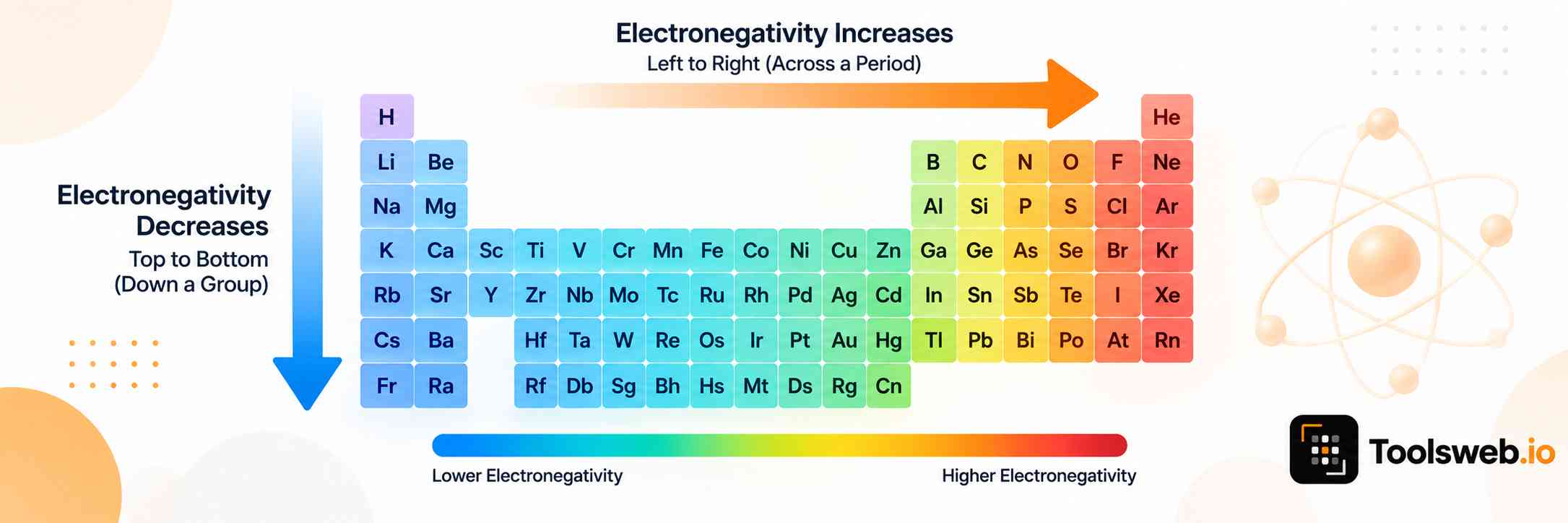
Electronegativity Calculator showing periodic table trends, with electronegativity increasing across periods and decreasing down groups.

How can you use our Electronegativity Calculator?

Our Electronegativity Calculator compares two atoms and quickly gives their ΔEN, bond type, polarity, and estimated ionic character.

Step 1

Select Two Atoms

Choose the two atoms you want to compare from the available elements.

Step 2

View Electronegativity Difference

Get the electronegativity difference between the selected atoms on the Pauling scale.

Step 3

Analyze Bond Properties

View the predicted bond type, ionic character, and bond polarity instantly.

How to calculate Electronegativity manually

You can compare atoms manually by using an electronegativity scale. For most school chemistry problems, start with the Pauling values and calculate their difference.

Using the Pauling Scale

Formula

The Pauling scale gives standard electronegativity values for elements. To compare two atoms, use ΔEN=∣EN1−EN2∣\Delta EN = |EN_1 - EN_2|.

Step by step guide

  1. Find the Pauling value for the first atom.
  2. Find the value for the second atom.
  3. Subtract the smaller value from the larger value.
  4. Use the ΔEN result to classify the bond.

Practical Example

For Na and Cl, use ENNa=0.93EN_{Na}=0.93 and ENCl=3.16EN_{Cl}=3.16. Therefore, ΔEN=∣0.93−3.16∣=2.23\Delta EN=|0.93-3.16|=2.23. This suggests an ionic bond under common classroom rules.

Using the Mulliken Scale

Formula

The Mulliken scale uses ionization energy and electron affinity. Its formula is χM=(I+A)/2\chi_M=(I+A)/2. Both values must use the same energy unit.

Step by step guide

  1. Find the atom's ionization energy.
  2. Find its electron affinity.
  3. Add both values together.
  4. Divide the total by two.
  5. Use the result as the Mulliken electronegativity.

Practical Example

Suppose an atom has I=10I=10 eV and A=2A=2 eV. Then χM=(10+2)/2=6\chi_M=(10+2)/2=6 eV. This value represents the atom's Mulliken electronegativity.

Using the Allred Rochow Scale

Formula

The Allred Rochow formula uses effective nuclear charge and covalent radius. A common form is χAR=0.359Zeff/r2+0.744\chi_{AR}=0.359Z_{eff}/r^2+0.744.

Step by step guide

  1. Find the atom's effective nuclear charge.
  2. Find its covalent radius in angstroms.
  3. Square the covalent radius.
  4. Divide ZeffZ_{eff} by r2r^2.
  5. Apply the formula to get electronegativity.

Practical Example

If Zeff=4Z_{eff}=4 and r=1.0r=1.0 Å, then χAR=0.359(4)/12+0.744=2.18\chi_{AR}=0.359(4)/1^2+0.744=2.18. This demonstrates the calculation method.

How to Calculate Electronegativity Difference

Formula

Electronegativity difference measures how far apart two atoms are on an electronegativity scale. Use ΔEN=∣EN1−EN2∣\Delta EN=|EN_1-EN_2|.

Step by step guide

  1. Find the electronegativity value for atom one.
  2. Find the value for atom two.
  3. Subtract one value from the other.
  4. Ignore the negative sign by taking the absolute value.
  5. Compare ΔEN with common bond classification ranges.

Practical Example

Hydrogen has EN=2.20EN=2.20, while chlorine has EN=3.16EN=3.16. Therefore, ΔEN=∣2.20−3.16∣=0.96\Delta EN=|2.20-3.16|=0.96. This commonly indicates a polar covalent bond.

Electronegativity Difference and Bond Type

Electronegativity difference helps predict whether a chemical bond is nonpolar covalent, polar covalent, or ionic.

Nonpolar Covalent Bonds

A nonpolar covalent bond has a small electronegativity difference. The atoms share bonding electrons almost equally. A common classroom cutoff is ΔEN<0.4\Delta EN<0.4.

Polar Covalent Bonds

A polar covalent bond has unequal electron sharing. One atom attracts the shared electrons more strongly. A common classroom range is about 0.4≤ΔEN≤1.70.4\leq\Delta EN\leq1.7.

Ionic Bonds

An ionic bond has a large electronegativity difference. One atom strongly attracts electrons from the other. A common classroom rule classifies ΔEN>1.7\Delta EN>1.7 as ionic.

Does ΔEN Alone Determine Bond Type?

No. ΔEN gives a useful prediction, but it does not describe every real bond. Chemical bonding also depends on electron structure and other atomic factors.

Explore Chemistry Calculators

Find chemistry calculators for reactions, solutions, molarity, stoichiometry, and more.

Frequently Asked Questions

These answers explain electronegativity trends, element values, bond types, ΔEN calculations, ionic character, and chemical bonding.